
Every exception found at the close was created weeks earlier, back when someone still remembered it. No report recovers that; only moving the review closer to the activity does.
Month-end problems don’t begin at month-end. They begin during the month.
A work order stays open when it should have been closed. An inventory adjustment gets made without a clear explanation. A deposit is handled incorrectly. A credit is left unresolved. A transaction is posted to the wrong account. An old receivable stays open because everyone assumes somebody else has it.
None of those is dramatic on its own. Then accounting starts closing the month and finds all of them at once.
The natural response is: we need a report for that.
A report can show you the problem. It cannot make anyone own it.
For any recurring problem, there are five questions worth answering before you build anything.
01
What exactly are we looking for?
02
How often should somebody review it?
03
What makes something unusual enough to investigate?
04
Who is responsible for following up?
05
What happens after we find one?
If those are unclear, you can have excellent reports and still go through the same cleanup every single month. The information exists. The process around the information does not.
Open is not the same as needs attention
Most exception reviews come apart right here, so it’s worth being careful about.
An item doesn’t belong on an exception list simply because it is open. A work order may be open because it’s waiting on a known backordered part, the customer has already been updated, the expected date is understood, and a review date is already on the calendar. That job may be completely under control today.
Open and under control
Waiting on a known backordered part
The customer has already been updated
The expected date is known
A future review date is already set
Open and needs action
No clear next action
Unusually long without activity
Waiting on us, not on anyone else
A customer commitment has been missed
Somebody needs to step in
Open doesn’t automatically mean it needs attention today. The purpose of the review is to separate what’s open and under control from what’s open and needs action.
That distinction also changes how a manager should work a report. Don’t work a report from top to bottom simply because that’s the order the system printed it in.
01
Decide what question this review is trying to answer.
02
Filter out what’s already under control.
03
Narrow it to records that need action, communication, a decision, or somebody to intervene.
04
Prioritize what’s left.
What you prioritize on depends on the week, but it’s usually some combination of these.
A missed promise or due date
A delay we control
Time since meaningful activity
Customer impact
Dollars involved
Age
An open-work-order report may run 150 jobs. The weekly review may only need the twelve that are past your normal threshold, have no clear next action, or need somebody to step in. That’s the difference between a report and a review.
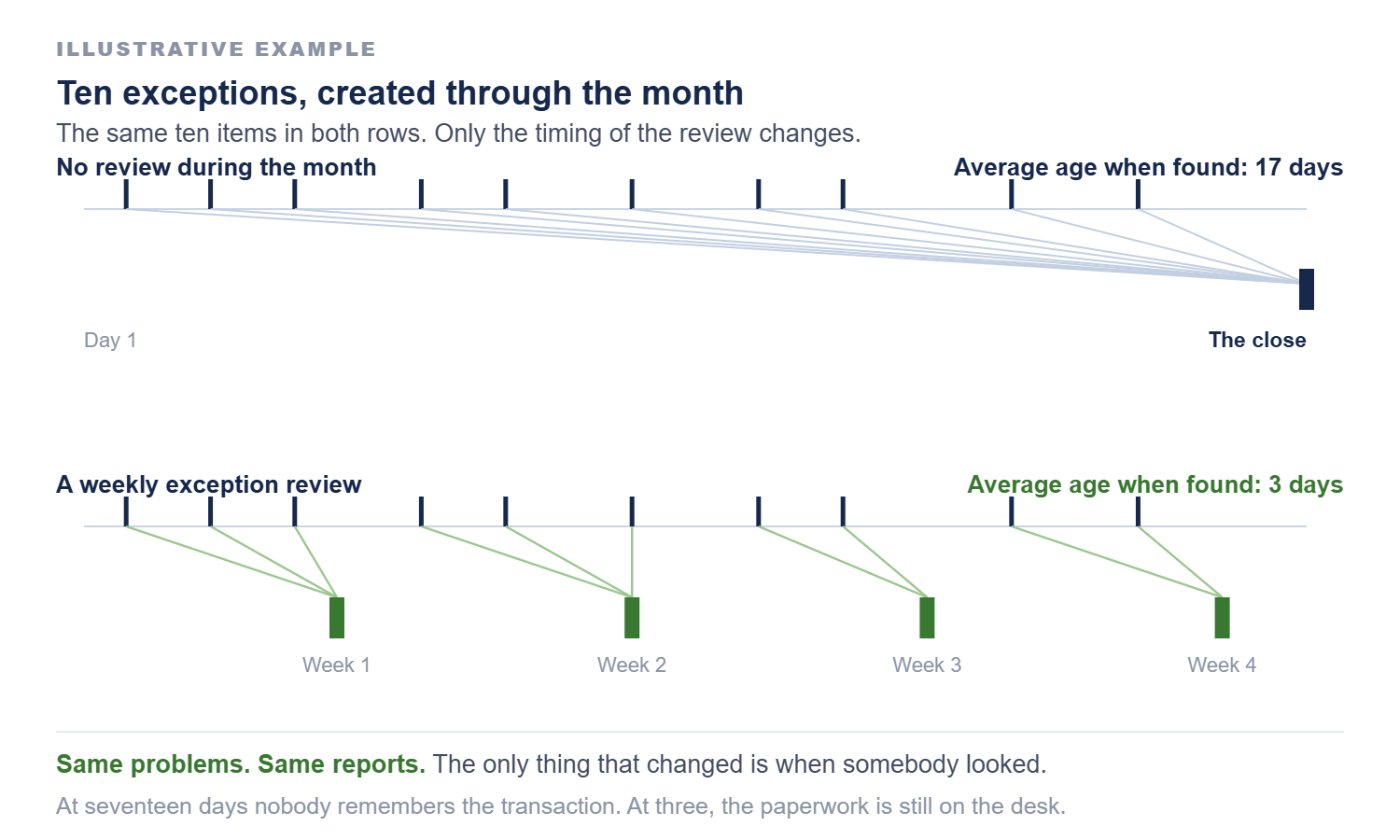
The earlier you find it, the easier it is
Say you regularly find work orders at month-end that should have been closed weeks earlier. You can run the report on the last day of the month and clean them up. Or open work orders past a certain age could be reviewed every week, completed units checked every few days, and somebody in service could own the review instead of accounting discovering it after the fact.
The difference is not the report. It is how close the review happens to the activity that created the problem.
Found at the close
Nobody remembers the transaction. The paperwork takes digging. The employee involved may be off this week. The customer conversation was three weeks ago. You’re reconstructing what happened.
Found the same week
People remember. The documents are still at hand. The employee is right there. The customer interaction is recent. You’re asking a question, not running an investigation.
Same problem, same report, and a completely different amount of work to resolve it.
Month-end should be confirming, not discovering
A healthy close gradually becomes more about confirming than discovering.
Accounting will always have work at close. Balances get reconciled, entries get made, statements get reviewed. But the close gets far easier when the obvious exceptions have already been handled during the month: old work orders reviewed regularly, unusual inventory adjustments investigated when they happen, aged receivables with clear ownership, deposits reconciled consistently, open credits reviewed, odd balances questioned before the last day.
None of that is complicated. All of its value comes from consistency.
Repeated cleanup is telling you something
Everybody has the occasional mistake. The interesting case is the same mistake appearing month after month.
If accounting fixes the same thing every close, it has probably stopped being an accounting problem. It’s a process problem somewhere upstream. Maybe the instructions are unclear. Maybe responsibility was never assigned. Maybe the system is being used inconsistently. Maybe the review happens too late. Maybe nobody outside accounting understands what their entry does downstream.
That’s where training and plain conversation between departments matter more than software. The goal is not for accounting to get better at cleaning up the problem. It is to create the problem less often.
Accounting shouldn’t be the house detective
Controllers and bookkeepers tend to become the people who notice when something doesn’t fit. That’s part of the job.
But there’s a difference between catching the occasional exception and spending every close tracking down issues that could have been settled weeks earlier.
The working principle is that the department creating or controlling an activity should own the first review of it. Accounting verifies the financial effect. It shouldn’t automatically own the resolution of every operating issue, and it shouldn’t become the default owner simply because accounting is where the problem eventually surfaces.
Service owns service activity. Parts owns parts activity. Sales owns sales activity. The cleaner the activity is before it reaches accounting, the cleaner the close becomes.
What this looks like on a calendar
In practice this tends to be two habits rather than a project: a short daily huddle, and a weekly review where the exceptions get worked.
A daily huddle can usually be kept to five or ten minutes. It should be short enough that it never becomes another long meeting. Depending on the size and structure of the business, that might be the whole team together or each department separately — either works, as long as it stays brief and nobody is reading reports aloud. It is not a walk through reports — it is clearing the road so the day can run.
The weekly review is where the exception lists get opened, with the people who own them there. Every item leaves it one of two ways: confirmed as under control, with a reason, or attached to a name and a date.
A workable rhythm
Daily huddle
Completed work not yet delivered or invoiced
Owning department
Jobs opened with no status or next step
Owning department
Customer orders ready with no completed customer contact
Owning department
Deliveries committed for today
Owning department
Weekly review
Work orders open past your threshold, with the reason
Owning department
Inventory adjustments over your dollar limit
Owning department
Quotes or orders with no next step
Owning department
Receivables past terms, listed by who owns them
Owning department
Before the close
Open credits still unresolved
Accounting
Deposits not yet reconciled
Accounting
Balances that don’t look right
Controller
Which department owns which line varies. A delivery, an inventory adjustment or a customer order may belong to different people depending on how the business is set up. The department creating or controlling the activity should usually own the first review of it.
The thresholds are yours to set. What counts as an old work order in one shop may be normal in another, and a dollar threshold that makes sense at one sales volume may not at another. Start with thresholds that surface a manageable number of meaningful exceptions, then adjust them as you learn what is useful.
You can’t make people keep running a process they don’t see the value in. That’s worth accepting before you build one, because it changes what you build.
Three things tend to decide whether a review is still happening six months later.
Whether the person leading it has the authority to act on it. A review loses credibility quickly when whoever runs it can’t resolve what it finds. The person responsible needs enough standing to ask the questions, assign a next step, and expect an answer. In some businesses that is the owner or general manager. In others it’s the department manager closest to the work, which is usually the better answer — the point is not to make the owner personally responsible for every operating control.
Whether the findings are real. It’s easy to make a list look clean without actually resolving what’s on it — marking items reviewed, explained or complete simply to get through the report. A clean list is not the goal. Resolved exceptions are. A falsely clean report is arguably worse than an obviously unfinished one, because it creates confidence that the issue was handled.
Whether it stays short enough to hold attention. If a weekly review runs an hour, the criteria are too wide and the focus is gone well before the end of the list. The answer is to narrow what qualifies as an exception, not to stop reviewing. Six things somebody acts on are more useful than sixty things nobody finishes.
The last two are the same failure pointing in opposite directions. One clears the list without doing the work. The other never gets through the list at all. Either way the review stops meaning anything — and once that happens, people stop showing up for it, which is usually the real reason a good process dies.
More reports are not the answer
Reports matter. You cannot manage what you cannot see. But visibility is one part of a process, not the whole of it.
When something causes trouble at close, fixing it may mean a weekly review, a clearer procedure, one more field being maintained properly, some training, a department owning its own exceptions, a different report, a simple checklist, or a five-minute conversation between two people who had never spoken about it. Small changes remove a surprising amount of month-end friction.
The value comes when the business knows what to notice, when to notice it, who owns it, and what happens next.
That’s what turns information into a control. And when those controls run throughout the month, month-end gets easier for everybody.
How this connects
Area: Administration — controls, timing, and the month-end close.
Applies across: Operations and Executive — almost every month-end problem is created somewhere other than accounting.
Read next: Building Follow-Up That Doesn’t Rely on Memory — the same questions of ownership and next actions, applied to the commitments your people make to customers.
Also useful: Vista Intelligence — if you would rather not build these exception lists by hand every week.
ProfitEdge Systems helps independent retailers and dealers improve profitability and operating performance through consulting, training, and intelligence tools. See how we help →

Free checklist
The Physical Inventory Planning Checklist
Two pages. Everything to do six weeks, two weeks and one week out, the count-day rules, and a review sheet that shows the gross variance, not just the net. One email address, nothing else.
Free follow-up kit
The Follow-Up Kit
Four printable pieces: a short huddle playbook for managers, the huddle form, a one-page field job aid, and a guide to turning the reports you already have into working lists. One email address, nothing else.
Free self-check
The Exit-Readiness Self-Check
Two pages. What still runs through you, the four questions a buyer or successor will ask, and a place to name your first three gaps. One email address, nothing else.
Free worksheet
The Shrink Investigation Worksheet
Two pages. A five-step check for every significant variance, an item log, where shortages hide in an equipment and hardware store, and how to spot a pattern before anyone is accused. One email address, nothing else.
Free self-check
The Small-Office Controls Self-Check
Two pages. Who does what on a payment, the five control activities, first fixes for a two-person office, and a login review. One email address, nothing else.
Free counter log
The Missed-Sale Log
Two pages. A counter log for every request you couldn’t fill, a weekly review that gives each signal an owner, and a place to track patterns across the month. One email address, nothing else.
Free account review
The Commercial Account Review
Two pages. A snapshot of your five most important commercial, fleet, municipal or farm accounts: what they run, the terms on file, and what each account really earns. One email address, nothing else.
Free planning sheet
The Before-the-PO Planning Sheet
Two pages. Why you’re buying it, four questions to answer before the cash goes out, the program on one page, and how to run a controlled test when the evidence is thin. One email address, nothing else.
Free template
The Customer Deposit Policy Template
Two pages. Write your deposit terms once, set how deposits are handled at the counter, and reconcile open deposits every month. One email address, nothing else.
Free worksheet
The Revenue Leak Worksheet
Two pages. Check warranty, co-op and programs, labor, vendor terms and floorplan, put a yearly dollar figure on each leak, and rank them against shrink with an owner for every fix. One email address, nothing else.
Free morning review
The Work Order Stage Review
Two pages. A morning sheet for every open job, with its stage, what it’s waiting on, the next step and who owns it, plus a stage-by-stage count of where work stalls. One email address, nothing else.
Free monthly review
Monthly Margin Questions
Two pages. The four questions an owner should be able to answer every month, set out as a sheet to fill in when the statement arrives, with a checklist of where margin drifts. One email address, nothing else.
Free planning sheet
The Decision-First Report Request
Two pages. Before asking for a new report or a new system, write down the decision, who makes it, how often, what counts as an exception and whether the data can be trusted. One email address, nothing else.
Free working sheet
The Month-End Exception Review
Two pages. The five questions worth settling before you build anything, and a daily / weekly / before-the-close sheet with the owner column left blank for your own names. One email address, nothing else.

Shrink Isn’t Only Theft
When the count comes up short, theft is the first thought. Often the stock was never there, or it left without anyone recording it. Sort the cause before you act.

Trust Is Not a Control
Controls are not a judgment about anyone. They are a judgment about whether one person could move money and hide it, and they protect the people you trust most.

Commercial and Fleet Customers Are Different
A down mower is a frustrating weekend for a homeowner. For a landscaper, it is a crew standing still.

Customer Deposits Aren’t Your Money Yet
A deposit is money you are holding, not money you have earned. Book it as a sale and the numbers start telling a story that is not true.
Bring the problem you keep re-solving
Most of what ends up in these articles started as a question from a shop owner or a dealer principal. If something here sounds like your month, say so and we will look at it together.
