
When the count comes up short, the first thought is theft. Sometimes that is right. Often, though, the missing stock was never really there, or it left the building without anyone recording it.
Shrink is the gap between what the system says you have and what’s actually on the shelf. It is a result, not a cause. Treating every shortage as theft sends people looking in the wrong place, and the receiving errors, unposted parts and unrecorded transfers behind the rest of the gap keep happening.
Theft deserves attention. It’s just one of several reasons the record and the shelf disagree, and the only one that starts as a security problem.
What shrink actually measures
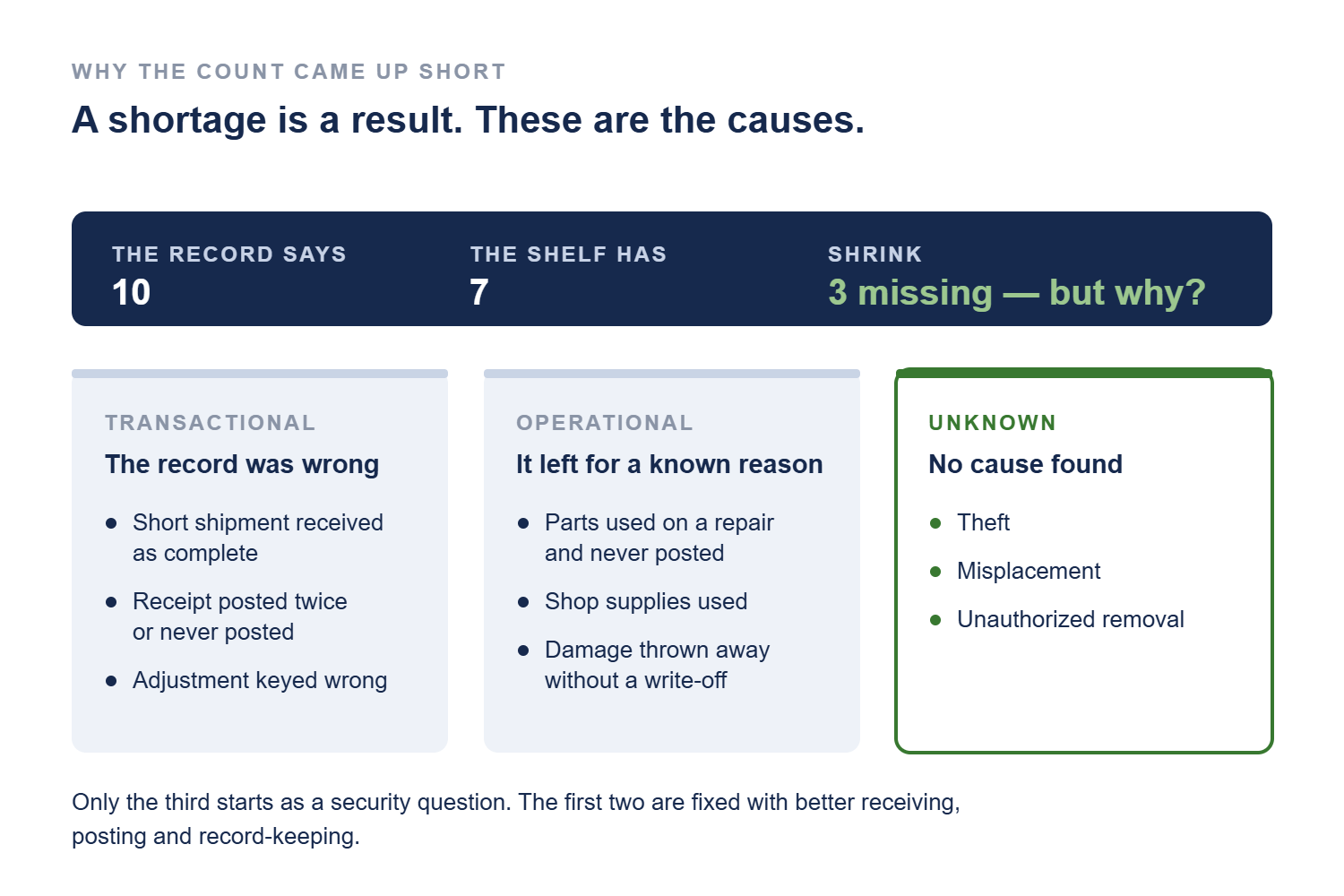
If the system says ten and the shelf has seven, three are missing. Multiply by cost and that is the shrink value. The arithmetic is simple. What it doesn’t tell you is why.
That matters because the fix depends entirely on the cause. A receiving problem needs a receiving fix. A parts-posting problem needs a service fix. Neither one is solved by a camera.
Three kinds of shrink
Transactional
The stock was never there, or the record was wrong. Missed or duplicated receipts, posting errors, receiving discrepancies, adjustments keyed incorrectly.
Operational
The stock left for a known reason nobody recorded. Damage, breakage, parts used on warranty work, shop supplies consumed in the service department.
Unknown
No cause can be found after looking. Theft, misplacement, unauthorized removal. This is the one that needs a security response.
Classifying a shortage before acting on it is what keeps the response proportionate. A store that treats every variance as unknown spends its energy on suspicion. A store that sorts them first finds out how much of the gap has an ordinary cause, and ordinary causes can be fixed with process.
Where it hides in an equipment and hardware store
Some causes are specific to the way independent dealers and hardware stores work. These are the ones worth checking first.
Short shipments received as complete — the vendor sent eight, the receipt says ten
Parts pulled for a repair and never posted to the work order
Shop supplies — oil, lubricants and chemicals used in the shop with no transaction
Bulk items sold by the foot — chain from a roll, hose from a reel — without the right conversion
Transfers between locations shipped from one store and never received at the other
Case-versus-each setup — an item stocked by the case and sold by the piece, or the reverse
Demonstration units and display stock with no record of where they went
Damaged goods thrown away without being written off
Each of these can produce a shortage that looks exactly like theft on a count sheet. None of them involves anyone taking anything.
Overages are a warning too
A count that comes in higher than the record is not a gain. It means the record is wrong in the other direction, and it distorts reordering, valuation and purchasing just as much as a shortage does.
Overages come from the same kinds of transaction problems: a receipt posted twice, a sale that never posted, parts consumed on a job but never taken out of stock. Stock in the wrong location shows up the same way — short in one bin, over in another.
A quantity below zero is the clearest sign of all. Nothing can be on a shelf in negative numbers, so a negative on-hand is always a record problem, often a receipt that was missed or posted after the sale. Correcting the number without finding the cause just means it comes back.
Check the count before you blame anyone
Before a shortage becomes an accusation or a write-off, it should go through the same short sequence every time.
01
Confirm the count itself: the right item, the right location, the right unit of measure.
02
Review the transaction history: receipts, sales, transfers, adjustments, work orders and rentals.
03
Look at the item’s past: earlier variances, how it moves, how it’s handled.
04
Name the cause: transactional, operational or unknown.
05
Fix the cause, not just the quantity.
Counts go wrong too — a case counted as one, the overflow location missed, a look-alike part counted in the wrong bin. A variance that turns out to be a counting error should be corrected and noted, not investigated as a loss.
Patterns tell you more than single shortages
One shortage on one item is often noise. The same item coming up short count after count is a signal. So is shortage that clusters in one place.
The same item, again and again
A chronic process problem with that item: how it’s received, stocked, sold or used in the shop.
One location or area
A handling or security issue specific to that spot: the yard, the back room, the shop floor.
One department
A systemic process gap, often in how that department records what it uses.
No cause after investigation
The point where a shortage becomes a security question and gets escalated.
A number you can measure is a number you can reduce
The basic defenses aren’t complicated: accurate receiving, so stock enters the system correctly; secured storage and controlled access for high-value items; and regular counting, so the record is checked against the shelf more than once a year.
A business that can’t say what its shrink is has no protection in this area. It has a hope.
Once shrink is measured and sorted by cause, it stops being an unexplained loss at year-end and becomes a short list of fixable problems. The theft that remains is then a smaller, clearer number, and much easier to act on.
Where to start
01
Pick the items with the largest shortages and run each through the five-step check.
02
Sort what you find into transactional, operational and unknown.
03
Fix the causes that come up most often. Receiving and parts posting are good places to start.
04
Count the problem items more often until they stay accurate.
05
Escalate only what remains unexplained.
How this connects
Area: Loss Prevention — inventory protection, the loss that shows up when the count disagrees with the record.
Applies across: Operations — receiving, the parts counter and the service department all affect inventory accuracy.
Read next: Getting a Physical Inventory You Can Trust — counting through the year so the annual count confirms the record.
Also useful: The Loss You Watch Is Rarely the Largest One — why shrink is only one part of loss prevention.
ProfitEdge Systems helps independent retailers and dealers improve profitability and operating performance through consulting, training, and intelligence tools. See how we help →

Free checklist
The Physical Inventory Planning Checklist
Two pages. Everything to do six weeks, two weeks and one week out, the count-day rules, and a review sheet that shows the gross variance, not just the net. One email address, nothing else.
Free follow-up kit
The Follow-Up Kit
Four printable pieces: a short huddle playbook for managers, the huddle form, a one-page field job aid, and a guide to turning the reports you already have into working lists. One email address, nothing else.
Free self-check
The Exit-Readiness Self-Check
Two pages. What still runs through you, the four questions a buyer or successor will ask, and a place to name your first three gaps. One email address, nothing else.
Free worksheet
The Shrink Investigation Worksheet
Two pages. A five-step check for every significant variance, an item log, where shortages hide in an equipment and hardware store, and how to spot a pattern before anyone is accused. One email address, nothing else.
Free self-check
The Small-Office Controls Self-Check
Two pages. Who does what on a payment, the five control activities, first fixes for a two-person office, and a login review. One email address, nothing else.
Free counter log
The Missed-Sale Log
Two pages. A counter log for every request you couldn’t fill, a weekly review that gives each signal an owner, and a place to track patterns across the month. One email address, nothing else.
Free account review
The Commercial Account Review
Two pages. A snapshot of your five most important commercial, fleet, municipal or farm accounts: what they run, the terms on file, and what each account really earns. One email address, nothing else.
Free planning sheet
The Before-the-PO Planning Sheet
Two pages. Why you’re buying it, four questions to answer before the cash goes out, the program on one page, and how to run a controlled test when the evidence is thin. One email address, nothing else.
Free template
The Customer Deposit Policy Template
Two pages. Write your deposit terms once, set how deposits are handled at the counter, and reconcile open deposits every month. One email address, nothing else.
Free worksheet
The Revenue Leak Worksheet
Two pages. Check warranty, co-op and programs, labor, vendor terms and floorplan, put a yearly dollar figure on each leak, and rank them against shrink with an owner for every fix. One email address, nothing else.
Free morning review
The Work Order Stage Review
Two pages. A morning sheet for every open job, with its stage, what it’s waiting on, the next step and who owns it, plus a stage-by-stage count of where work stalls. One email address, nothing else.
Free monthly review
Monthly Margin Questions
Two pages. The four questions an owner should be able to answer every month, set out as a sheet to fill in when the statement arrives, with a checklist of where margin drifts. One email address, nothing else.
Free planning sheet
The Decision-First Report Request
Two pages. Before asking for a new report or a new system, write down the decision, who makes it, how often, what counts as an exception and whether the data can be trusted. One email address, nothing else.
Free working sheet
The Month-End Exception Review
Two pages. The five questions worth settling before you build anything, and a daily / weekly / before-the-close sheet with the owner column left blank for your own names. One email address, nothing else.

Shrink Isn’t Only Theft
When the count comes up short, theft is the first thought. Often the stock was never there, or it left without anyone recording it. Sort the cause before you act.

Trust Is Not a Control
Controls are not a judgment about anyone. They are a judgment about whether one person could move money and hide it, and they protect the people you trust most.

Commercial and Fleet Customers Are Different
A down mower is a frustrating weekend for a homeowner. For a landscaper, it is a crew standing still.

Customer Deposits Aren’t Your Money Yet
A deposit is money you are holding, not money you have earned. Book it as a sale and the numbers start telling a story that is not true.
Bring the problem you keep re-solving
Most of what ends up in these articles started as a question from a shop owner or a dealer principal. If something here sounds like your month, say so and we will look at it together.
