
An annual physical should confirm that the inventory is right. In too many businesses it’s the one day a year they find out it is wrong.
For most independent retailers and dealers, the physical inventory is the day the whole business stops to look at what it owns. It’s expensive in hours, disruptive, and nobody enjoys it, so the natural goal becomes getting it over with.
That’s understandable, and it’s how a business ends up with a count it can’t trust. Some go much longer without one. We once helped a retailer complete its first physical inventory in about twenty years. That was twenty years of decisions about what to order, what to promote and what the business was worth, all resting on numbers nobody had verified.
Why one day matters for the whole year
The count does three jobs. It sets the inventory value for the year-end financials. It resets the on-hand quantities the system uses to decide what to reorder. And it turns up the discrepancies that nothing else found: items in the wrong place, areas nobody counted all year, records that have been wrong for a long time.
A bad count doesn’t stay wrong for one day. It stays wrong until the next one. Items that were over-counted don’t get reordered when they should. Items that were under-counted get bought again. And the margin on every report for the next twelve months is a little less true than it looks.
The goal, over time, is for the annual physical to validate the inventory rather than restore it. Accuracy is maintained all year through good receiving, controlled adjustments and regular counting of the items that matter most. The physical confirms that it worked.
Pick the date before you plan the count
The count date is usually tied to fiscal year end, so confirm it with your accountant first. For many hardware and outdoor power businesses on a calendar year, that lands in late December or early January, right on top of holiday returns and the turn of the season.
If you have any choice, count at the seasonal low point. Fewer units on hand means fewer to count, less overflow to miss and a smaller potential adjustment. For a spring and summer-heavy equipment dealer, that can mean late January or early February, and some dealers set their fiscal year to end at their own low point for exactly this reason.
Most of the work happens before the count
A well-run physical is planned four to six weeks ahead. A well-prepared count with an average crew beats a rushed count with a great one.
6 wks
Set the date and the freeze window. Assign a counter and a backup to every area of the building, and catch up on any areas the year’s cycle counts missed.
2 wks
Post every pending receipt, return and adjustment. Decide what happens to everything in the returns area. Walk the building for product with no location or no tag.
1 wk
Brief the count teams. Agree how anything that doesn’t scan, has no tag or is in the wrong place will be handled, and who decides.
Day
Freeze transactions, count blind, and recount the large variances before the freeze lifts.
Two of those deserve a word. Counting blind means the count sheets show the location and the item but not what the system thinks is there. A counter who can see the expected number tends to find it. Recounting before the freeze lifts, ideally by a different person, catches the miscounts while the shelf still matches the moment of the count.
Whether you use an outside counting service or your own staff, the preparation is yours. A service can count quickly. It can’t know that a case of 24 is set up in the system as an each, or that the pallet by the dock belongs to a customer.
What dealers and service departments need to add
A count is only accurate if it gets the item, the quantity, the location and the ownership right. An operation with equipment, service or rental has more ways to get the last one wrong.
Wholegoods counted by serial number, not by model
Parts already pulled to open work orders
Customer units in the shop kept clearly apart
Consigned and special-order stock identified
Rental fleet handled separately from sale inventory
Warranty parts waiting on a return or a claim
Open work orders deserve particular care. Parts that are physically on a bench but still in inventory on the system will either be missed in the count or counted while also being charged to a job. Decide ahead of time how each case is handled, and make sure the counters and the service team are using the same rule.
The review is the point
Once the counting stops, the temptation is to post the results and move on. That’s the step that most often gets skipped, and it’s the one that decides whether the count was worth doing.
Suppose a business carrying $900,000 in inventory finishes its count $6,000 short. Less than one percent. It looks fine, and it gets posted.
Net variance
−$6,000
The number that usually gets reported. Small, reassuring, and not the whole story.
Gross variance
$102,000
$48,000 over and $54,000 short, cancelling each other out on the summary page.
The net number says the inventory is close. The gross number says more than eleven percent of it was wrong in one direction or the other, and each of those overs and shorts was a reorder that went wrong or a margin figure that was off, all year.
The overs deserve as much attention as the shorts. Finding more than the system expected sounds like good news, but it’s almost always a process failure: a delivery received twice, a customer return put back into stock that never actually came back, a vendor credit entered as a receipt. If it happened on the way in, it’s still happening.
Work the variances in this order
The largest dollar variances, in either direction
Locations where one side was zero — nothing on the shelf, or nothing in the system
Items that come up wrong in the same direction year after year
Everything else, posted with a note after a reasonable look
That last line matters. The annual physical isn’t the time to trace every small discrepancy to its source. That’s what counting during the year is for. Investigate what’s large or repeating, post the rest, and get the results closed out within a couple of weeks while the trail is still fresh.
A variance is a symptom. Posting it fixes the number. Finding the process that caused it fixes next year.
Count a little all year
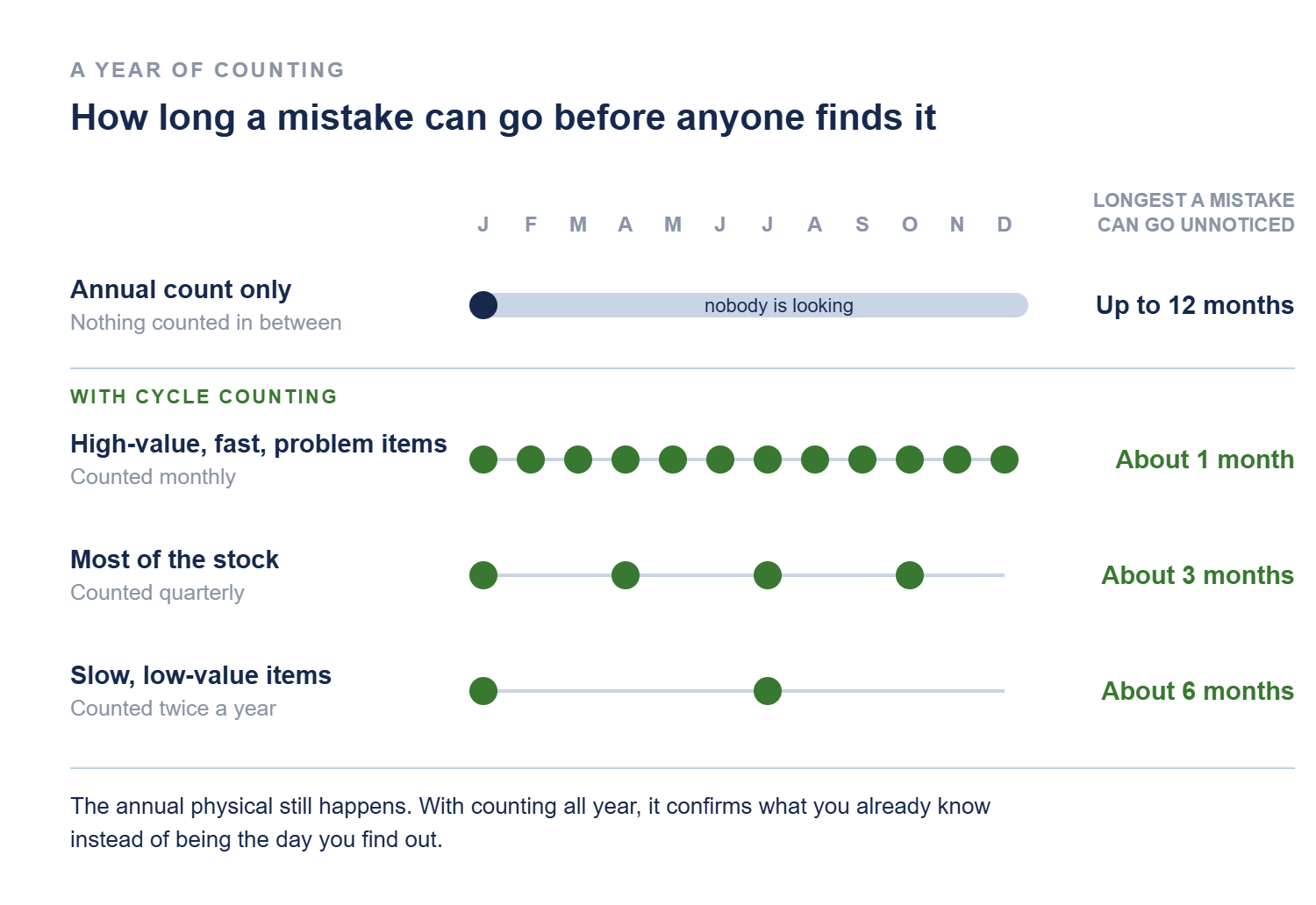
The single biggest thing that changes the annual physical is cycle counting: counting a small portion of the building on a rotating schedule, all year, while the store stays open. A session takes fifteen to thirty minutes. Discrepancies get caught within weeks of when they happened, while someone still remembers the delivery or the job that caused them, instead of surfacing twelve months later as a number nobody can explain.
A sensible floor is to count every location in the building at least once every 90 days. From there, count more often where the risk is.
Monthly
High value, fast moving, or a history of problems
Service parts, blades, belts, oil, batteries, serialized items, and anything that keeps coming up wrong.
Quarterly to twice a year
Everything else
Most hardware and accessories quarterly. Slow, low-value, long-tail items can stretch to every six months.
If you’re starting from nothing, don’t try to build the perfect schedule on day one. Put everything on a quarterly rotation for the first round, then move the locations that keep producing variances onto the monthly list. A quick way to pick the first monthly group is to take the top fifth of your items by sales dollars.
Habits that make it stick
A written schedule, not a mental list
A named person on a named day, not whoever has time
Count one zone at a time, not scattered locations
Count before opening where you can
Never count while a delivery is being received
Recount before posting any variance
The recount matters more than it sounds. The most common cause of a variance is a miscount, and a variance that disappears on recount is worth a note. It may mean the count was taken mid-transaction. And close every session: each location either confirmed, recounted or flagged for a closer look. A count that is started and left open is worse than no count, because it looks like work was done.
The year-end variance review is also a map of where the controls are weak. The items and areas that came up wrong this year are the ones to count more often next year, with the highest-value and fastest-moving items counted most often of all. The patterns behind them — receiving, returns, adjustments posted without a reason, parts leaving service without a ticket — are the processes to fix.
Done that way, the annual count stops being the one day a year the business finds out what happened. It becomes a confirmation of what the business already knows. That’s a much better day for everyone, and a much more useful number.
How this connects
Area: Operations — inventory accuracy and the numbers every other decision runs on.
Applies across: Administration and Loss Prevention — the count sets the year-end value and measures the shrink.
Read next: The Loss You Watch Is Rarely the Largest One — what shrink is made of, and the larger loss that never shows up in a count.
Also useful: Freeing Cash Trapped in Dead Stock — what to do with what the count turns up.
ProfitEdge Systems helps independent retailers and dealers improve profitability and operating performance through consulting, training, and intelligence tools. See how we help →

Free checklist
The Physical Inventory Planning Checklist
Two pages. Everything to do six weeks, two weeks and one week out, the count-day rules, and a review sheet that shows the gross variance, not just the net. One email address, nothing else.
Free follow-up kit
The Follow-Up Kit
Four printable pieces: a short huddle playbook for managers, the huddle form, a one-page field job aid, and a guide to turning the reports you already have into working lists. One email address, nothing else.
Free self-check
The Exit-Readiness Self-Check
Two pages. What still runs through you, the four questions a buyer or successor will ask, and a place to name your first three gaps. One email address, nothing else.
Free worksheet
The Shrink Investigation Worksheet
Two pages. A five-step check for every significant variance, an item log, where shortages hide in an equipment and hardware store, and how to spot a pattern before anyone is accused. One email address, nothing else.
Free self-check
The Small-Office Controls Self-Check
Two pages. Who does what on a payment, the five control activities, first fixes for a two-person office, and a login review. One email address, nothing else.
Free counter log
The Missed-Sale Log
Two pages. A counter log for every request you couldn’t fill, a weekly review that gives each signal an owner, and a place to track patterns across the month. One email address, nothing else.
Free account review
The Commercial Account Review
Two pages. A snapshot of your five most important commercial, fleet, municipal or farm accounts: what they run, the terms on file, and what each account really earns. One email address, nothing else.
Free planning sheet
The Before-the-PO Planning Sheet
Two pages. Why you’re buying it, four questions to answer before the cash goes out, the program on one page, and how to run a controlled test when the evidence is thin. One email address, nothing else.
Free template
The Customer Deposit Policy Template
Two pages. Write your deposit terms once, set how deposits are handled at the counter, and reconcile open deposits every month. One email address, nothing else.
Free worksheet
The Revenue Leak Worksheet
Two pages. Check warranty, co-op and programs, labor, vendor terms and floorplan, put a yearly dollar figure on each leak, and rank them against shrink with an owner for every fix. One email address, nothing else.
Free morning review
The Work Order Stage Review
Two pages. A morning sheet for every open job, with its stage, what it’s waiting on, the next step and who owns it, plus a stage-by-stage count of where work stalls. One email address, nothing else.
Free monthly review
Monthly Margin Questions
Two pages. The four questions an owner should be able to answer every month, set out as a sheet to fill in when the statement arrives, with a checklist of where margin drifts. One email address, nothing else.
Free planning sheet
The Decision-First Report Request
Two pages. Before asking for a new report or a new system, write down the decision, who makes it, how often, what counts as an exception and whether the data can be trusted. One email address, nothing else.
Free working sheet
The Month-End Exception Review
Two pages. The five questions worth settling before you build anything, and a daily / weekly / before-the-close sheet with the owner column left blank for your own names. One email address, nothing else.

Shrink Isn’t Only Theft
When the count comes up short, theft is the first thought. Often the stock was never there, or it left without anyone recording it. Sort the cause before you act.

Trust Is Not a Control
Controls are not a judgment about anyone. They are a judgment about whether one person could move money and hide it, and they protect the people you trust most.

Commercial and Fleet Customers Are Different
A down mower is a frustrating weekend for a homeowner. For a landscaper, it is a crew standing still.

Customer Deposits Aren’t Your Money Yet
A deposit is money you are holding, not money you have earned. Book it as a sale and the numbers start telling a story that is not true.
Bring the problem you keep re-solving
Most of what ends up in these articles started as a question from a shop owner or a dealer principal. If something here sounds like your month, say so and we will look at it together.
