
Follow-up is the management of open commitments: keeping the promise visible, knowing who owns the next step, keeping the customer informed, and learning from the places where work repeatedly gets stuck.
Almost nobody in your business needs convincing that follow-up matters. Your people already know.
The challenge is keeping track of it while everything else is happening. A customer is waiting on a quote. Another has money down on an open sales order. A service estimate needs authorization. A special-order part is coming in. A warranty claim needs another document. A vendor promised an answer. Someone said, “Call me next week.”
Meanwhile the phones are ringing, customers are at the counter, technicians need information, freight arrives, and the day keeps moving.
The problem is almost never a lack of good intentions. It is that memory has quietly become the follow-up system.
A good process makes the commitment visible, gives it an owner, and makes the next step clear.
Follow-up is bigger than sales
Sales follow-up is the most obvious example, but a dealership creates open commitments in almost every department. If you only build a process for one of them, the rest keep running on memory.
Sales
Quotes, trade values, financing, ordered units, attachments, delivery commitments, and customers who want to be contacted when something becomes available.
Service
Estimate authorization, promised status updates, declined repairs, parts delays, completed work, and warranty decisions.
Parts
Special orders, backorders, superseded parts, customer requests, and arrival notifications.
Warranty & administration
Claims needing information, rejected claims, credits, documentation, insurance items, and vendor issues.
Accounting & management
Disputed invoices, promised payments, credits, unapplied items, and questions someone has promised to research or resolve.
Rental & equipment orders
Reservations, incoming units, overdue returns, damage questions, and delivery updates.
The thing being tracked is not always a sales lead. Sometimes it is an opportunity. Sometimes it is a promise. Sometimes it is simply an unresolved issue that someone needs to keep moving.
Track the commitment, not just the customer
A customer record tells you who the person is. It does not necessarily tell you what your business promised to do next.
“I’ll check with the manufacturer and call you back.” “We’ll let you know when the part arrives.” “I’ll get an answer from warranty.” “Call me when you get another one in.”
Those are commitments, and none of them lives in a customer record. For every active item, four things should be easy to see. They are the backbone of a dependable follow-up process.
Status
Where is it now, and what are we waiting on?
Owner
Who is responsible for making sure it moves?
Next action
What exactly needs to happen next?
Review date
When will we act or look again if nothing changes?
When there is a promised or expected event — a part arrival, an approval, a delivery, a payment, a manufacturer response, or a customer decision — record that date separately from the review date. They are not the same thing, and treating them as one is how items disappear.
The commitment itself should also be specific enough that another employee can understand what is outstanding. And when the item is finished, close it with a real outcome, so completed work does not stay open forever.
Start with the tools you already have
Before you create another spreadsheet or add another tool, spend a little time looking at what your current system can already do.
Many businesses already have useful features inside their DMS, ERP, point-of-sale, CRM, service, accounting, email, or customer communication systems that were never fully set up, were never taught to the team, or simply fell out of use.
You may already have a way to assign a task, set a reminder, schedule a customer communication, record contact history, create service reminders, or build a list of customers who need attention. If you do, start there.
| Capability | What to look for | Why it matters |
|---|---|---|
| Visibility | Open-item reports, aging reports, status lists, customer-order lists | Shows what is still open or may need attention. |
| Follow-up management | Tasks, reminders, assigned activities, due dates, notes, owners | Turns an open item into a clear responsibility and next action. |
| Customer communication | Email and text tools, contact history, templates, service reminders | Helps you communicate consistently and preserve what happened. |
If your current system handles those jobs reasonably well, use it. The goal is a dependable follow-up process, not simply another place to keep a list.
Don’t look only for a report called “Follow-Up”
Some of the best follow-up lists in a dealership are not labeled as follow-up at all. Report names vary by system, so look for the function rather than the exact title.
Open Sales Orders / Uncompleted Orders
Especially deposits or payments on file, promised dates missed, product available but not delivered, and orders with no recent activity.
Open Quotes / Outstanding Estimates
Especially overdue follow-up, no next action, or meaningful opportunities that have gone quiet.
Open Work Orders / Work Order Aging
Especially delays you control, no recent activity, authorization delays, or jobs past a promised date.
Awaiting Authorization
Diagnosed work that cannot move until the customer responds or is contacted.
Completed / Not Picked Up
Finished work where communication or pickup still needs to happen.
Parts Received / Not Picked Up
Customer parts sitting on the shelf after arrival, and customers not yet notified.
Special Orders / Backorders
Customers waiting on product, an ETA, or an update — especially missed ETAs and orders with no current ETA at all.
Open Warranty Claims / Claims Aging
Documentation, manufacturer decisions, corrections, or credits still outstanding.
AR Aging / Customer Disputes
Promised payments, questions, missing paperwork, or issues you still need to resolve.
A report is only the starting point
Most businesses already have the reports they need to find follow-up opportunities. The harder part is taking a long report and deciding what deserves attention today.
Filter first. Then order. Then review.
Filter. Include an item in today’s review when someone needs to act, check, communicate, decide, or intervene. Leave it out when it has a clear owner, a known next step, and a future review date that has not arrived yet.
Leaving an item out of today’s view does not mean forgetting it. It stays open in your operating system. It simply means the item is under control right now.
Order. Put the items that deserve the quickest attention near the top: missed customer commitments, delays you control, items with no clear next action, and records that have gone quiet. Age and dollar value are useful context after that — not automatic answers by themselves.
Do not work a report from top to bottom just because that is the order the system printed it in.
Use the report to find the records. Use context to decide which ones matter.
Open sales orders deserve special attention
Open sales orders are different from quotes. The customer may already have committed to the purchase. The order may contain product, a deposit or payment, an allocated unit, accessories, setup work, financing, or a promised delivery date.
An open order is not automatically a problem. A 28-day-old factory order with a known ETA, a recently updated customer, and a scheduled next contact may be completely under control.
A six-day-old order can deserve far more attention if the unit is in stock, setup is finished, the customer has paid a deposit, and nobody has scheduled delivery.
28 days old — under control
Factory order with a known ETA. Customer updated last week. Next contact already scheduled. Nothing to do today.
6 days old — needs action
Unit in stock, setup finished, deposit paid, no delivery scheduled and no call made. The customer’s money is here and their machine is not.
When you review open orders, look across the whole record rather than reading only the order date: customer, order value, deposit or payment, product status, availability, promised date, last meaningful activity, assigned employee, and balance due tell a much better story together.
Tell the customer what happens next
One of the simplest follow-up habits is also one of the most effective: tell the customer when they should expect to hear from you again.
Instead of “We’ll let you know,” try “I’ll check on this Wednesday and update you then.”
That promise creates clarity for the customer and a very clear next action for your business. And an update does not require new information. If Wednesday arrives and the manufacturer still has not responded, you can still say: I told you I’d update you today. We’re still waiting, but I wanted to keep you informed.
Good follow-up is not about contacting customers more often. It is about contacting them when there is a useful reason — and doing what you said you would do.
Use the right communication for the situation
Where your system allows it, record the customer’s preferred contact method. Some customers want a text. Some prefer email. Others expect a phone call, especially when the issue is important or complicated.
Routine communication can be a good place for automation. A service reminder, a notice that an ordered part has arrived, or an appointment confirmation may not require a personal call every time. But a high-value commercial customer with a disabled machine in the middle of the season probably deserves a human conversation.
Use automation where it makes communication more dependable. Keep people involved where context, judgment, or the relationship matters.
Waiting still needs a date
“Waiting on customer,” “waiting on parts,” and “waiting on manufacturer” are legitimate statuses. They should not become places where items disappear.
Two dates are often useful. The expected date is when the part, answer, approval, unit, credit, or other event is supposed to happen. The review date is when you will check again or take another action if the expected event has not happened.
Those are not always the same. If a vendor expects a backordered part in three weeks, you may decide to update the customer weekly rather than disappear for three weeks.
Age doesn’t decide priority by itself
The oldest follow-up is not automatically the most important one. A ten-day-old quote may be exactly where it should be if the customer asked to be called next week. A two-day-old service issue may deserve immediate attention if a commercial customer’s primary machine is down during peak season.
That is where judgment matters. What commitment did we make? Is the customer waiting on us? Is the situation time-sensitive? Are meaningful dollars involved? Has the item gone unusually quiet? Are we holding up the next step, or is an outside party?
Keep enough history for a clean handoff
Follow-up becomes fragile when all of the history lives with one employee. People take days off. Departments hand work to one another. Sales needs parts. Parts needs service. Service needs warranty. Customers call back and speak with whoever answers.
A useful note can be short
8/24 — Called customer. Waiting for spouse to review quote. Customer asked us to call Thursday afternoon.
The note does not need to be an essay. It needs to preserve enough context that the next employee can pick up the conversation intelligently.
A handoff is not complete because somebody sent an email, left a note, or told another department about it. It is complete when the next owner knows the item is theirs, the open commitment is visible to that person, and the next action and review date have been carried forward.
Close the loop and record what happened
A follow-up process becomes less useful when finished items remain open indefinitely. When an item is done, close it with a meaningful outcome. The choices can stay simple and vary by the type of work.
Sold
Declined
Postponed
No response after reasonable attempts
Purchased elsewhere
Authorized
Resolved
Warranty approved
Warranty denied
Credit received
No further action needed
Outcomes are useful for more than housekeeping. Over time they show patterns. Maybe you are losing more quotes to availability than to price. Maybe service follow-ups are repeatedly delayed by the same parts issue. Maybe warranty claims keep stalling because the same documentation is missing.
That is where follow-up starts teaching you something about the business.
Make follow-up part of the management rhythm
A report or task list can keep open items visible, but someone still needs to use the information. A short manager huddle is the practical way to turn follow-up into a regular operating habit.
A busy operation may benefit from a daily ten-minute huddle during peak season. A smaller store or a slower period may only need two or three huddles a week. Use the cadence that fits the volume and the season.
The huddle does not review every item. It stays focused on five questions.
01
Who is waiting on us?
Missed callbacks, orders waiting on delivery or paperwork, estimates waiting on revised information, received parts not communicated.
02
What is overdue?
Promised dates, next-action dates, review dates, and pickup or delivery commitments that have passed.
03
What hasn’t moved?
Items that may not be overdue but have gone quiet: no recent activity, too long in the same status, no next action, no owner.
04
Who needs help?
A trade approval, a manufacturer answer, a lender issue, a parts escalation, a warranty decision, or a cross-department handoff.
05
What can we close?
Finished, declined, postponed, resolved, picked up, delivered, or otherwise no longer active.
Before moving on from any item, make sure the status, owner, next action, and review date are clear again. That is what puts the item back under control.
A few ground rules keep it short
Do not read every open item aloud. Do not solve long problems in the huddle — assign the owner and move the longer conversation afterward. Focus on the next action, not on blame for how the item got there. Customer commitments come first when your business is holding up the next step. A waiting status always needs an expected date or a review date. And close finished items, so the list stays trustworthy.
Learn from the pattern
Keep a weekly review separate from the short huddle. The huddle is tactical. The weekly review looks for recurring causes, training needs, workload problems, and process changes.
What keeps happening that we should fix instead of continuing to follow up on it?
The same commitment repeatedly going overdue. Items repeatedly sitting in “waiting on parts” without a review date. The same handoff between departments consistently causing delays. Work repeatedly reaching the huddle with no owner. One employee carrying an unreasonable number of open items. Those are process problems wearing a follow-up costume.
Activity counts can be useful, but a high number of calls or emails does not mean customers are being taken care of. The measures that tell you whether the process is healthy are usually these:
Open items with no owner
Open items with no next action or review date
Overdue customer commitments
Customers currently waiting on us
Items with no meaningful activity for an unusual amount of time
Open sales orders past a promised date, or with product available and no completion plan
Start simple, then improve what you learn
You do not need to implement every possible report or follow-up list at once. Start with two or three areas where commitments are most likely to get lost — perhaps open sales orders, open work orders, and customer parts. Use the tools and reports you already have, build the habit there, and expand only after the process is working.
You also cannot make people keep running a process they do not see the value in. That is worth accepting before you build one, because it changes what you build. A review survives when the person leading it can actually act on what it finds, when the findings are real rather than cleared to make the list look clean, and when it stays short enough to hold attention.
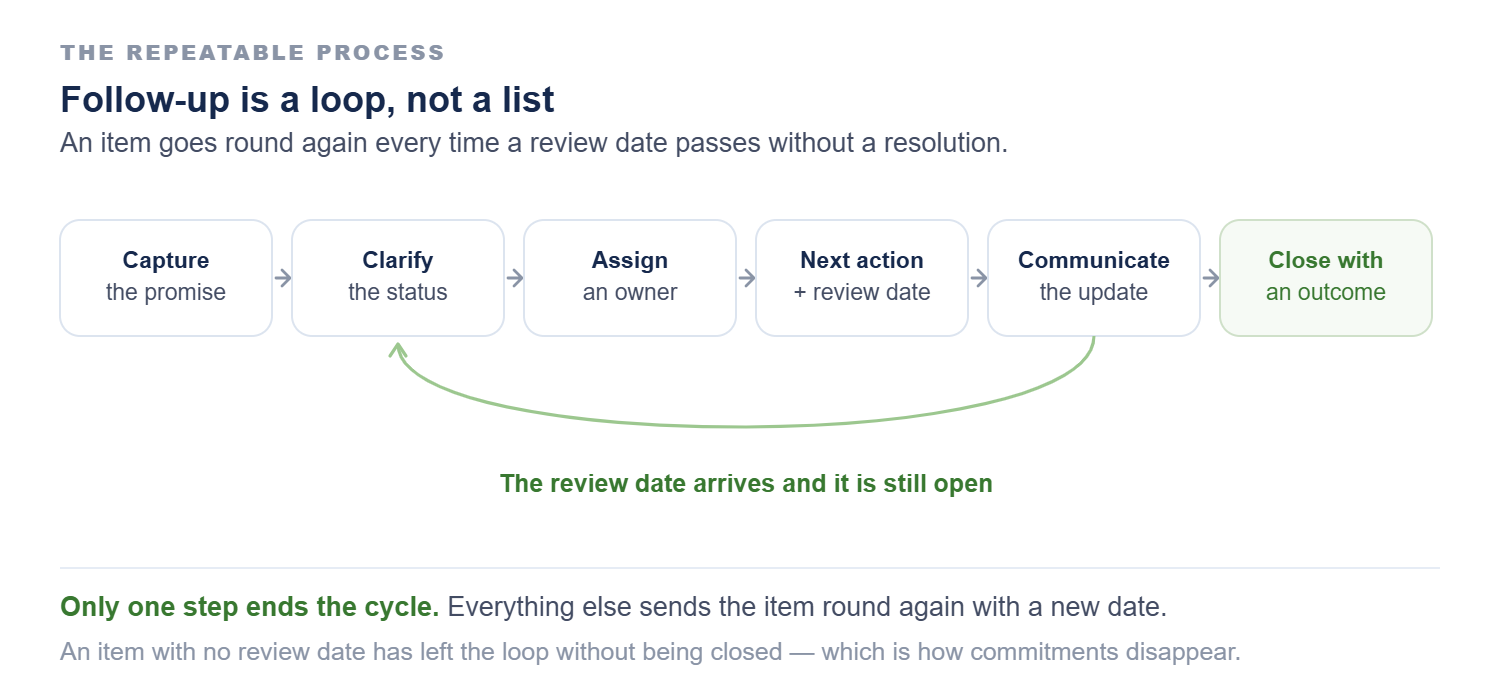
The repeatable process
Capture → clarify the status → give it an owner → set the next action and review date → communicate → close the loop → learn from the pattern.
The method matters more than the tool. The best follow-up system is not the one with the most features. It is the one that helps good employees keep the promises they already intend to keep — and helps the business get better at keeping them.
Take this with you
Three companion pieces put this into practice on your counter and in your management meeting.
Follow-Up Field Job Aid (PDF) — the repeatable process on one page, for the counter or the parts desk.
Follow-Up Huddle Playbook (PDF) — the ten-minute manager routine, the five questions, and the ground rules that keep it short.
Follow-Up Reports & Systems Guide (PDF) — how to turn the reports you already have into a focused working list.
How this connects
Area: Revenue — opportunities, quotes, and customer commitments.
Applies across: Operations and Administration — every department makes promises that need keeping.
Read next: Why More Reports Won’t Fix Your Month-End — the same questions of ownership and next actions, applied to the close.
Also useful: Turning Work Orders Into a Production System — the service department’s version of the same discipline.
ProfitEdge Systems helps independent retailers and dealers improve profitability and operating performance through consulting, training, and intelligence tools. See how we help →

Free working sheet
The Month-End Exception Review
Two pages. The five questions worth settling before you build anything, and a daily / weekly / before-the-close sheet with the owner column left blank for your own names. One email address, nothing else.
You Cannot Sell Your Way to a Better Year
Growth is the instinct when profit is short. It is rarely the fastest lever an owner has.
Building Follow-Up That Doesn’t Rely on Memory
A repeatable process that protects opportunities without making customer relationships feel scripted.

Why More Reports Won’t Fix Your Month-End
The problem usually is not data. It is controls, timing, and who owns the follow-up.

Turning Work Orders Into a Production System
Knowing how many work orders are open tells you very little. Knowing where each one is stuck tells you almost everything.
Bring the problem you keep re-solving
Most of what ends up in these articles started as a question from a shop owner or a dealer principal. If something here sounds like your month, say so and we will look at it together.