
A deposit feels like a sale. The customer has committed and the money is in the bank. But until the unit is delivered or the order filled, the business owes the customer one of two things: the product, or the money back.
That makes a deposit a liability, not revenue. It’s a small accounting distinction that has surprisingly large consequences, because handled loosely, deposits inflate one month’s profit, shortchange another’s, create disputes with customers, and go missing without anyone noticing.
Deposits are rarely the largest number in the back office. They carry more risk than their size suggests, because the mistakes don’t show up as mistakes. They show up as a good month.
A deposit is not a sale
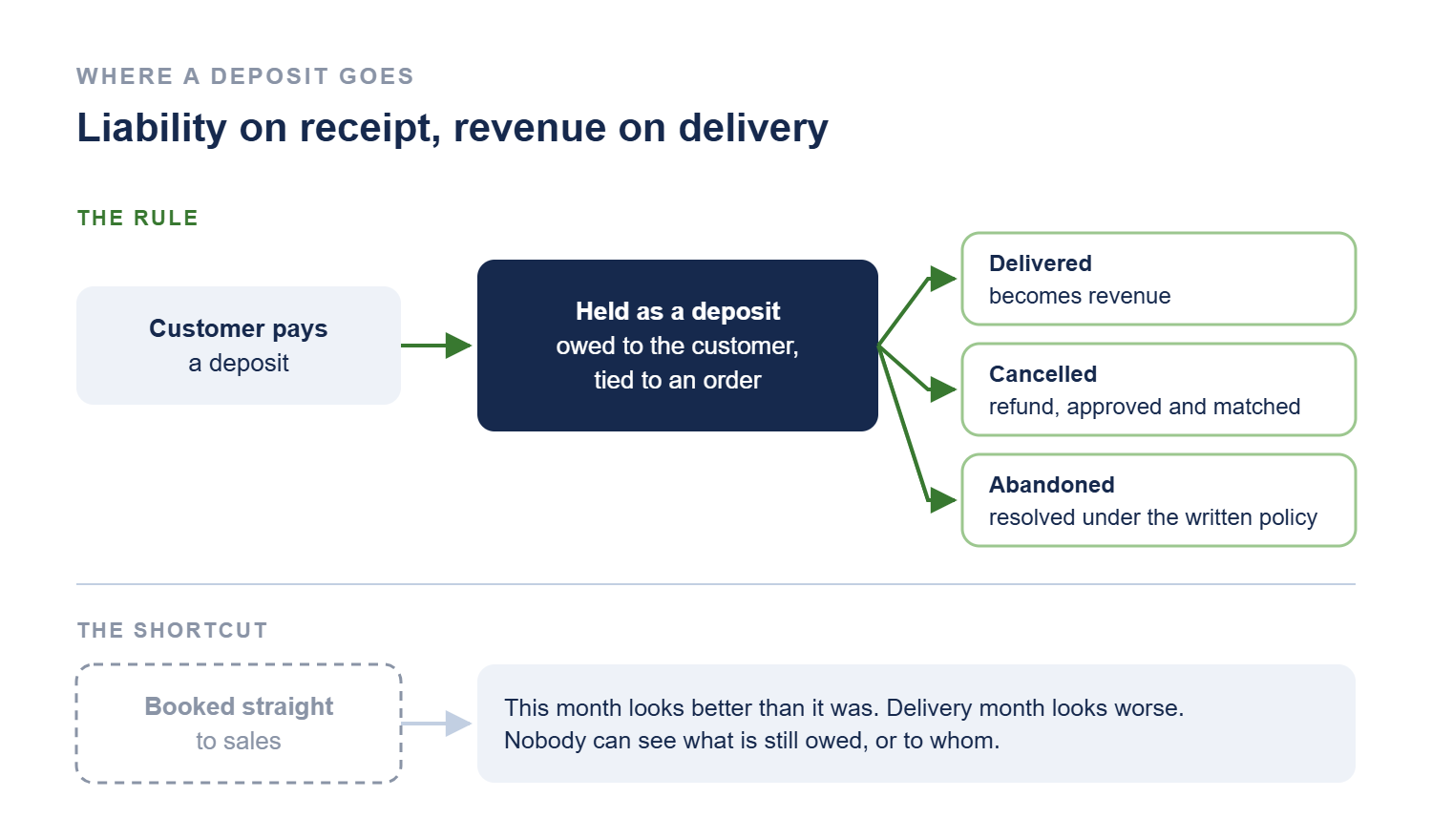
When a deposit is recorded as a sale the day it’s taken, the month it was taken looks better than it was. The month the unit is actually delivered looks worse, because the revenue was already counted. Decisions get made on a profit figure that was partly borrowed from the future.
Booked as a sale
This month looks strong. Delivery month looks weak. Nobody can see what’s still owed to whom, and an abandoned order’s money is mixed into revenue.
Held as a deposit
The money is recorded as owed to a named customer against a specific order. It becomes revenue when the order is delivered, and not before.
“Liability on receipt, revenue on delivery” is the whole rule. Everything else in this article is about keeping it true.
What counts as a deposit
Down payments on units still to be delivered
Prepayment on special-order parts
Staged payments on builds and rigging
Money taken before a service job is finished
Holds to reserve an item for a customer
Anything collected before the customer has what they paid for
They all follow the same rule, and each one needs to be tied to the specific customer and order it belongs to. A deposit balance that is just a lump sum — with no detail of whose money it is or what it is for — cannot be reconciled, refunded correctly or cleared at delivery. That ambiguity is where deposits get lost.
Where deposits go wrong
Most deposit problems come from a handful of ordinary habits, and none of them feel like a problem when they happen.
Deposits rung up as sales “to keep it simple”
Deposits collected at the counter but never recorded against an order
Units delivered without the deposit being applied, so it’s still on the books months later
Special orders abandoned, with the money left in limbo and nobody deciding whose it is
Refunds issued without checking them against a recorded deposit
That last one is a control issue as much as an accounting one. A refund is money leaving the business. A refund with no matching deposit behind it is exactly the kind of transaction that needs a second look, whether the cause is an honest mistake or something else.
Six habits that keep deposits honest
01
Record every deposit as owed to the customer, not as a sale.
02
Tie each one to a named customer and a specific unit, part order or job.
03
Reconcile monthly: the total on the books should equal the open deposits, each tied to an order that is still open.
04
Review aged and abandoned deposits on a schedule, and resolve them.
05
Require approval for refunds, matched to the deposit being returned.
06
Have a written deposit policy, and follow it every time.
The monthly reconciliation is the habit that catches the rest. It finds deposits that were collected but never recorded, and deposits that were earned at delivery but never cleared. Both leave the balance wrong, and both hide real money.
A deposit balance that keeps growing, with old orders in it, is not a cushion. It is a sign that money was collected and something was never finished.
A balanced account can still be unhealthy
Deposits are unusual in one way. The account can reconcile perfectly — every dollar on the books matched to a recorded deposit — and still be telling a misleading story. A deposit balance that grows steadily can look like a healthy order book while it’s really filling up with deposits on units delivered long ago and orders nobody is coming back for.
So once deposits are being recorded properly, it’s worth looking at how they move, not just whether they balance.
How long deposits are held — compared with your normal lead time for that kind of order
The aged tail — deposits still open well past any reasonable lead time
Cleared at delivery — whether deposits come off the books when the unit leaves
Abandoned orders — how many, and whether they have been resolved
The balance trend — whether it’s growing faster than orders are
Refund disputes — how often a customer and the store disagree about what was agreed
Each pattern points to a specific fix. A balance growing faster than orders usually means deposits aren’t being cleared when units are delivered, so the delivery step needs to include applying the deposit. A long aged tail usually means abandoned orders that nobody has resolved. Frequent disputes usually mean the policy is unwritten, or written and not followed.
Abandoned deposits also deserve attention for a less obvious reason. Money held for a customer who never comes back doesn’t simply become the store’s after a while. Depending on your policy and your state, it may need to be refunded, formally forfeited under terms the customer agreed to, or handled under unclaimed-property rules. That’s a question for your accountant, and it’s much easier to answer for a handful of recent deposits than for years of them.
Because deposits decide when revenue is recognized, they belong in the same monthly review as the close. A deposit balance that isn’t clearing properly is not really a deposit problem. It is a profit-accuracy problem that happens to show up in the deposit account.
What a clean-up tends to find
Consider a dealer that books unit down payments straight to sales and has never kept a separate deposit account. When someone finally looks, two things turn up.
First, the strong months were partly made of deposits on units that hadn’t been delivered yet, so the business had been reading its own results as better than they were. Second, a handful of old special-order deposits belonged to orders abandoned long ago. That money was owed either to the customers or, under the store’s policy, to the dealer — but nobody had decided which, so it was in limbo.
Neither problem was dramatic. Fixing both was routine: hold deposits separately, reconcile monthly, tie each one to an order, and work through the old ones under a written policy. The point is that nothing on any report had flagged either issue. They only came out because someone went looking.
Write the policy down
Most deposit disputes with customers come from the same place: two people remembering different terms. A short written policy removes the guesswork, protects the customer and the store equally, and means the counter gives the same answer no matter who is working.
How much deposit is required for units, special orders and builds
What is refundable, and what is not
How long an order or hold is kept
What happens to a deposit when an order is abandoned
Put the terms on the receipt or order form, so the customer has them too. A deposit handled this way is simple: it comes in, it waits against an order, and it becomes a sale the day the customer has what they paid for. That’s all it ever needed to be.
How this connects
Area: Administration — administrative operations, and money held on a customer’s behalf.
Applies across: Revenue and Operations — deposits are taken at the sales and parts counters, and cleared when the unit or order is delivered.
Read next: Why More Reports Won’t Fix Your Month-End — the close is where an unreconciled deposit balance finally shows up.
Also useful: The Loss You Watch Is Rarely the Largest One — refunds and controls as part of loss prevention.
ProfitEdge Systems helps independent retailers and dealers improve profitability and operating performance through consulting, training, and intelligence tools. See how we help →

Free checklist
The Physical Inventory Planning Checklist
Two pages. Everything to do six weeks, two weeks and one week out, the count-day rules, and a review sheet that shows the gross variance, not just the net. One email address, nothing else.
Free follow-up kit
The Follow-Up Kit
Four printable pieces: a short huddle playbook for managers, the huddle form, a one-page field job aid, and a guide to turning the reports you already have into working lists. One email address, nothing else.
Free self-check
The Exit-Readiness Self-Check
Two pages. What still runs through you, the four questions a buyer or successor will ask, and a place to name your first three gaps. One email address, nothing else.
Free worksheet
The Shrink Investigation Worksheet
Two pages. A five-step check for every significant variance, an item log, where shortages hide in an equipment and hardware store, and how to spot a pattern before anyone is accused. One email address, nothing else.
Free self-check
The Small-Office Controls Self-Check
Two pages. Who does what on a payment, the five control activities, first fixes for a two-person office, and a login review. One email address, nothing else.
Free counter log
The Missed-Sale Log
Two pages. A counter log for every request you couldn’t fill, a weekly review that gives each signal an owner, and a place to track patterns across the month. One email address, nothing else.
Free account review
The Commercial Account Review
Two pages. A snapshot of your five most important commercial, fleet, municipal or farm accounts: what they run, the terms on file, and what each account really earns. One email address, nothing else.
Free planning sheet
The Before-the-PO Planning Sheet
Two pages. Why you’re buying it, four questions to answer before the cash goes out, the program on one page, and how to run a controlled test when the evidence is thin. One email address, nothing else.
Free template
The Customer Deposit Policy Template
Two pages. Write your deposit terms once, set how deposits are handled at the counter, and reconcile open deposits every month. One email address, nothing else.
Free worksheet
The Revenue Leak Worksheet
Two pages. Check warranty, co-op and programs, labor, vendor terms and floorplan, put a yearly dollar figure on each leak, and rank them against shrink with an owner for every fix. One email address, nothing else.
Free morning review
The Work Order Stage Review
Two pages. A morning sheet for every open job, with its stage, what it’s waiting on, the next step and who owns it, plus a stage-by-stage count of where work stalls. One email address, nothing else.
Free monthly review
Monthly Margin Questions
Two pages. The four questions an owner should be able to answer every month, set out as a sheet to fill in when the statement arrives, with a checklist of where margin drifts. One email address, nothing else.
Free planning sheet
The Decision-First Report Request
Two pages. Before asking for a new report or a new system, write down the decision, who makes it, how often, what counts as an exception and whether the data can be trusted. One email address, nothing else.
Free working sheet
The Month-End Exception Review
Two pages. The five questions worth settling before you build anything, and a daily / weekly / before-the-close sheet with the owner column left blank for your own names. One email address, nothing else.

Shrink Isn’t Only Theft
When the count comes up short, theft is the first thought. Often the stock was never there, or it left without anyone recording it. Sort the cause before you act.

Trust Is Not a Control
Controls are not a judgment about anyone. They are a judgment about whether one person could move money and hide it, and they protect the people you trust most.

Commercial and Fleet Customers Are Different
A down mower is a frustrating weekend for a homeowner. For a landscaper, it is a crew standing still.

Customer Deposits Aren’t Your Money Yet
A deposit is money you are holding, not money you have earned. Book it as a sale and the numbers start telling a story that is not true.
Bring the problem you keep re-solving
Most of what ends up in these articles started as a question from a shop owner or a dealer principal. If something here sounds like your month, say so and we will look at it together.
