
A customer asks for a part you don’t have and walks out. The sales report shows nothing — no sale, no margin, no movement. As far as the report is concerned, nothing happened.
But something did happen. A customer told the store exactly what they needed. If that happens once, it’s a small signal. If it happens six times in two weeks, it is demand. And unless somebody writes it down, the business will keep believing there was no demand because there were no sales.
Sales matter. They’re the cleanest proof that demand turned into money. They’re just not the whole story.
Sales are only the demand you caught
Captured demand
The customer needed something and the store turned it into a sale, a repair, a rental or an order. This is what the sales report shows.
Uncaptured demand
The customer needed something and left without it: the part was out, the quote went stale, the repair was declined, the rental unit was already gone. No report shows any of it.
Some of that uncaptured demand went to a competitor. Some of it went online. Some of it simply went away because the customer delayed, made do, or gave up. In every case, the store had the conversation and didn’t get the sale — and has no record that the conversation happened.
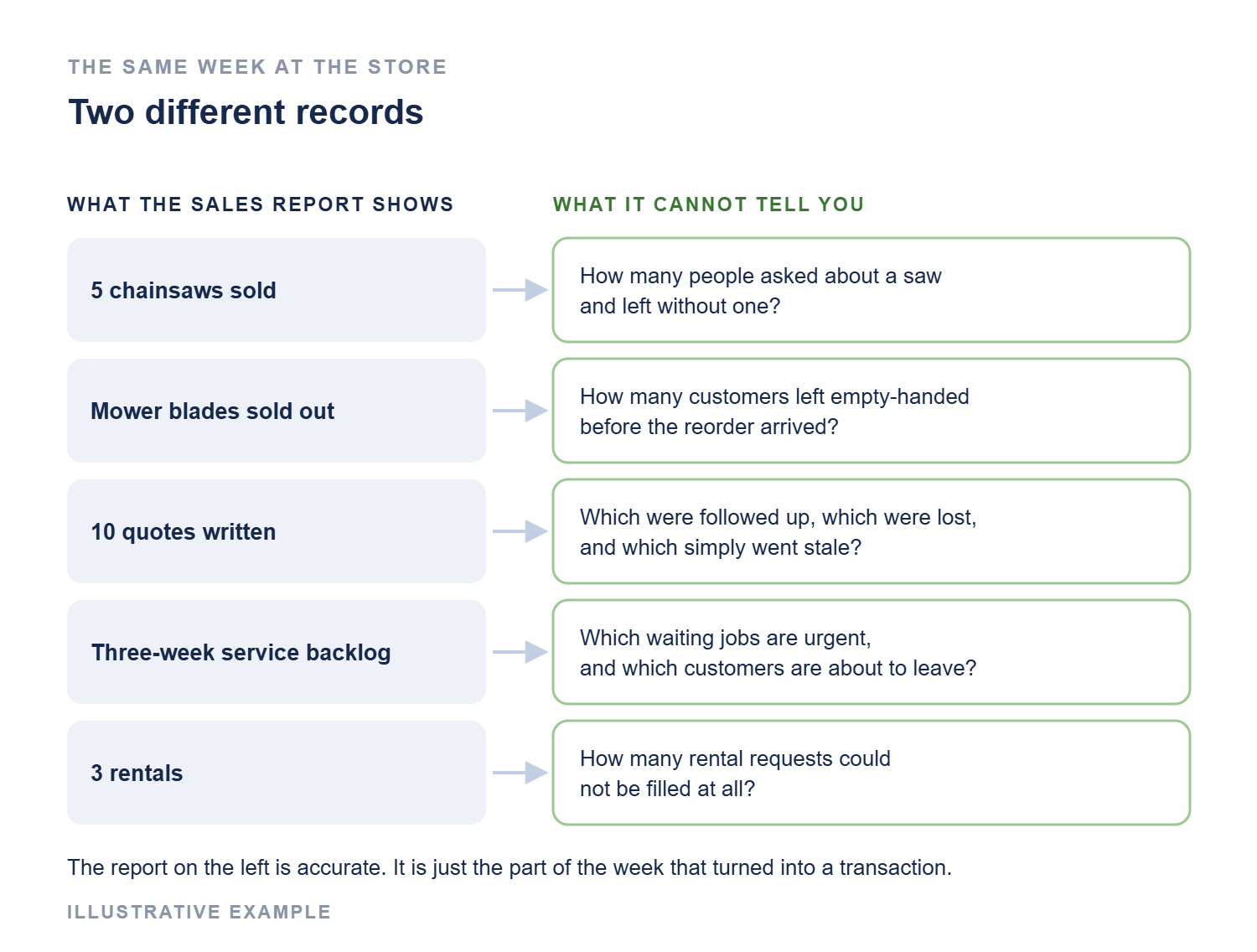
Where uncaptured demand shows up
It isn’t only a parts counter problem. Every department hears demand that never becomes a transaction.
Parts — stockouts nobody logs, the same special order placed again and again
Sales — quotes nobody follows up, “I’ll think about it” with no next step
Service — declined repairs that were really a replacement conversation
Service — work turned away or delayed because the shop was full
Rental — requests the fleet couldn’t fill
Commercial accounts — needs a customer raised that nobody took ownership of
The declined repair is easy to overlook. A customer who decides a machine isn’t worth fixing hasn’t stopped needing a machine. They have just told you, in so many words, that they’re about to buy one. Whether they buy it from you depends on whether anyone treats that “no” as the start of a conversation.
How a request turns into a loss
Missed demand rarely fails all at once. It usually breaks down at one of a few predictable points.
01
A customer shows a need — three people ask for the same tune-up kit after the first mowing weekend.
02
Nobody writes it down — the requests are remembered, or not.
03
Nobody owns it — parts assumes the buyer knows, and the buyer never hears.
04
Nothing happens next — no reorder, no call back, no update to the customer.
05
The customer buys elsewhere, and the pattern stays invisible.
That’s the same kind of loss as an unclaimed warranty or an expired co-op balance: money the business could have earned and never collected. It just happens at the counter instead of in the back office.
It rarely arrives as one big lost sale
Take battery-powered handheld equipment. A few customers ask the sales floor about it. A few ask the parts counter about batteries and chargers. Service hears customers wonder whether their gas units are worth fixing. Each person remembers it for a while, and none of it gets connected.
By the time the owner notices the shift, many of those customers have already bought from a big-box store or online. There was no single dramatic miss. There were dozens of small signals that the store heard and never put together — and a category decision that came a season late.
Sales are captured demand. Demand is the bigger story of what customers wanted, asked for, waited on, or went somewhere else to find.
What it sounds like on the floor
Uncaptured demand rarely announces itself. It shows up in ordinary things people say at the counter and in the shop, the kind of sentences that end a conversation instead of starting one.
“They asked, but we didn’t have it.” — a stocking signal, and a customer who may be back if someone calls when it arrives.
“They wanted a quote.” — buying interest that needs a status and a follow-up date.
“They said the repair was too much.” — a replacement conversation that hasn’t happened yet.
“We couldn’t get to it for three weeks.” — service demand larger than the shop could handle, and customers at risk of going elsewhere.
“We didn’t have a rental available.” — a fleet planning signal, and sometimes an equipment sale in waiting.
“They said they’d think about it.” — open demand with no next step attached.
Teaching the team to hear those sentences as information is most of the work. Once people know that “we didn’t have it” is worth writing down, they start writing it down.
It also helps to be clear about who acts on each signal. Stockouts and repeat special orders go to whoever does the buying. Open quotes go to the sales manager. Declined repairs go to sales as well as service, because the next conversation is about a new machine. Rental requests that couldn’t be filled belong in the next fleet review. A signal with no owner is just a note.
Make it easy to write down
You can’t measure demand perfectly, and you don’t need to. You need a simple way for the people who hear it to record it, and someone who looks at what was recorded.
Start with the system you already have. Many operating systems have a lost-sale or missed-sale function at the point of sale, and some track special orders and quote status as well. Some of this demand may already be recorded in your system. What’s usually missing is the habit around it: staff who know the function exists, know when to use it, and record it the same way every time — the item, the quantity, and why the sale didn’t happen, whether that was out of stock, not carried, price or timing. And then someone has to actually review what it collects.
If your system can’t record a missed sale, keep track of it manually. A simple log at the counter works, as long as it’s kept in one place and reviewed on a schedule. The tool matters much less than the two habits: record it every time, and look at it every week.
Either way, these are the signals worth capturing:
Missed sales and stockouts: the item, the date, the reason, and a way to reach the customer if they want a call when it arrives
Every open quote with a status and a follow-up date
Declined repairs kept on a list, with someone responsible for the replacement conversation
Special orders reviewed regularly for items that should simply be stocked
Rental requests that couldn’t be filled, noted by unit type and date
The recording only works if it leads somewhere. The buyer should see the stockout log. The sales manager should see the quote list. Someone should call the customer whose part has arrived. Demand that is written down but never reviewed is just a more organized way of losing the sale.
This is not forecasting
None of this requires predicting the future. It is learning to see the signals customers are already giving you, and treating a question at the counter with the same seriousness as an invoice.
The payoff is practical. Better stocking decisions, because they’re based on what people asked for and not only on what happened to be on the shelf. Fewer customers who leave and get in the habit of buying somewhere else. And a clearer picture of where the next sale is coming from, before the sales report can show it.
How this connects
Area: Revenue — demand, and the customer needs the sales report can’t see.
Applies across: Operations and Loss Prevention — what you stock is decided by what you notice, and missed demand is money that never arrives.
Read next: Need, Want, and Vendor Pressure — how to turn what customers ask for into what you actually buy.
Also useful: Building Follow-Up That Doesn’t Rely on Memory — keeping quotes and open conversations from going stale.
ProfitEdge Systems helps independent retailers and dealers improve profitability and operating performance through consulting, training, and intelligence tools. See how we help →

Free checklist
The Physical Inventory Planning Checklist
Two pages. Everything to do six weeks, two weeks and one week out, the count-day rules, and a review sheet that shows the gross variance, not just the net. One email address, nothing else.
Free follow-up kit
The Follow-Up Kit
Four printable pieces: a short huddle playbook for managers, the huddle form, a one-page field job aid, and a guide to turning the reports you already have into working lists. One email address, nothing else.
Free self-check
The Exit-Readiness Self-Check
Two pages. What still runs through you, the four questions a buyer or successor will ask, and a place to name your first three gaps. One email address, nothing else.
Free worksheet
The Shrink Investigation Worksheet
Two pages. A five-step check for every significant variance, an item log, where shortages hide in an equipment and hardware store, and how to spot a pattern before anyone is accused. One email address, nothing else.
Free self-check
The Small-Office Controls Self-Check
Two pages. Who does what on a payment, the five control activities, first fixes for a two-person office, and a login review. One email address, nothing else.
Free counter log
The Missed-Sale Log
Two pages. A counter log for every request you couldn’t fill, a weekly review that gives each signal an owner, and a place to track patterns across the month. One email address, nothing else.
Free account review
The Commercial Account Review
Two pages. A snapshot of your five most important commercial, fleet, municipal or farm accounts: what they run, the terms on file, and what each account really earns. One email address, nothing else.
Free planning sheet
The Before-the-PO Planning Sheet
Two pages. Why you’re buying it, four questions to answer before the cash goes out, the program on one page, and how to run a controlled test when the evidence is thin. One email address, nothing else.
Free template
The Customer Deposit Policy Template
Two pages. Write your deposit terms once, set how deposits are handled at the counter, and reconcile open deposits every month. One email address, nothing else.
Free worksheet
The Revenue Leak Worksheet
Two pages. Check warranty, co-op and programs, labor, vendor terms and floorplan, put a yearly dollar figure on each leak, and rank them against shrink with an owner for every fix. One email address, nothing else.
Free morning review
The Work Order Stage Review
Two pages. A morning sheet for every open job, with its stage, what it’s waiting on, the next step and who owns it, plus a stage-by-stage count of where work stalls. One email address, nothing else.
Free monthly review
Monthly Margin Questions
Two pages. The four questions an owner should be able to answer every month, set out as a sheet to fill in when the statement arrives, with a checklist of where margin drifts. One email address, nothing else.
Free planning sheet
The Decision-First Report Request
Two pages. Before asking for a new report or a new system, write down the decision, who makes it, how often, what counts as an exception and whether the data can be trusted. One email address, nothing else.
Free working sheet
The Month-End Exception Review
Two pages. The five questions worth settling before you build anything, and a daily / weekly / before-the-close sheet with the owner column left blank for your own names. One email address, nothing else.

Shrink Isn’t Only Theft
When the count comes up short, theft is the first thought. Often the stock was never there, or it left without anyone recording it. Sort the cause before you act.

Trust Is Not a Control
Controls are not a judgment about anyone. They are a judgment about whether one person could move money and hide it, and they protect the people you trust most.

Commercial and Fleet Customers Are Different
A down mower is a frustrating weekend for a homeowner. For a landscaper, it is a crew standing still.

Customer Deposits Aren’t Your Money Yet
A deposit is money you are holding, not money you have earned. Book it as a sale and the numbers start telling a story that is not true.
Bring the problem you keep re-solving
Most of what ends up in these articles started as a question from a shop owner or a dealer principal. If something here sounds like your month, say so and we will look at it together.
