
A homeowner with a down mower has a frustrating weekend. A landscaper with a down mower may have a crew waiting, jobs slipping and payroll running while the machine is in the shop. Same product, very different stakes.
That’s why commercial and fleet customers can’t be handled exactly like one-time retail transactions. They buy some of the same products, and they walk up to the same counter. But they’re operating businesses, and when their equipment is down, their revenue may be down with it.
The difference shows up in what they need from the dealership, in how they should be priced and served, and in what they’re worth over time — for better and, if the account isn’t managed, for worse.
They are buying uptime
The product matters, but the business outcome matters more. A mower is a crew staying productive. A saw is a job getting finished. A repair is revenue protected. The better question is not only what they’re buying. It is what happens to their business if the product, the part or the repair fails them.
Landscapers — uptime during the season, fast answers, parts on hand
Property managers — reliability across several sites, predictable support
Municipal and school buyers — formal quotes, clean paperwork, purchasing rules
Farms and ranches — dependable help when the work can’t wait
Fleet accounts — consistency across many machines and many users
All of them — someone who answers, and an update before they have to ask
Price matters to these customers, and they negotiate hard. But what they’re really weighing is total operating cost: how long a machine is down, how quickly a part arrives, whether they get a straight answer the first time. A dealership can win commercial work on availability, expertise and consistency, not only on the lowest number.
Bigger is not automatically better
Commercial customers can be some of the most valuable relationships a dealership has. They buy repeatedly across equipment, parts, service and replacement cycles, and they talk to other buyers. They can also become unprofitable without anyone noticing.
There’s a common belief that more commercial and fleet business is always better. It is not. These can be some of the most demanding customers in the building and some of the lowest-margin ones, expecting sharper pricing, faster service and easier terms all at once. The goal is not to chase one customer type over another. Homeowners, commercial accounts, farms and municipal buyers each bring something different to the business, and each should be priced and served so that it pays its own way.
An unmanaged account
Emergency priority becomes constant. Discounts pile up without review. Slow payment turns revenue into receivables. The shop resents the account, and the customer feels neglected anyway.
A managed account
Someone owns the relationship. Priority follows agreed rules. Pricing and terms are written down and reviewed. Repairs are planned more often than they are urgent.
The goal is not to treat commercial customers as royalty or as a problem. It is to manage each account as a relationship with real economics: what it brings in, what it costs to support, and whether it’s worth the shop capacity it consumes.
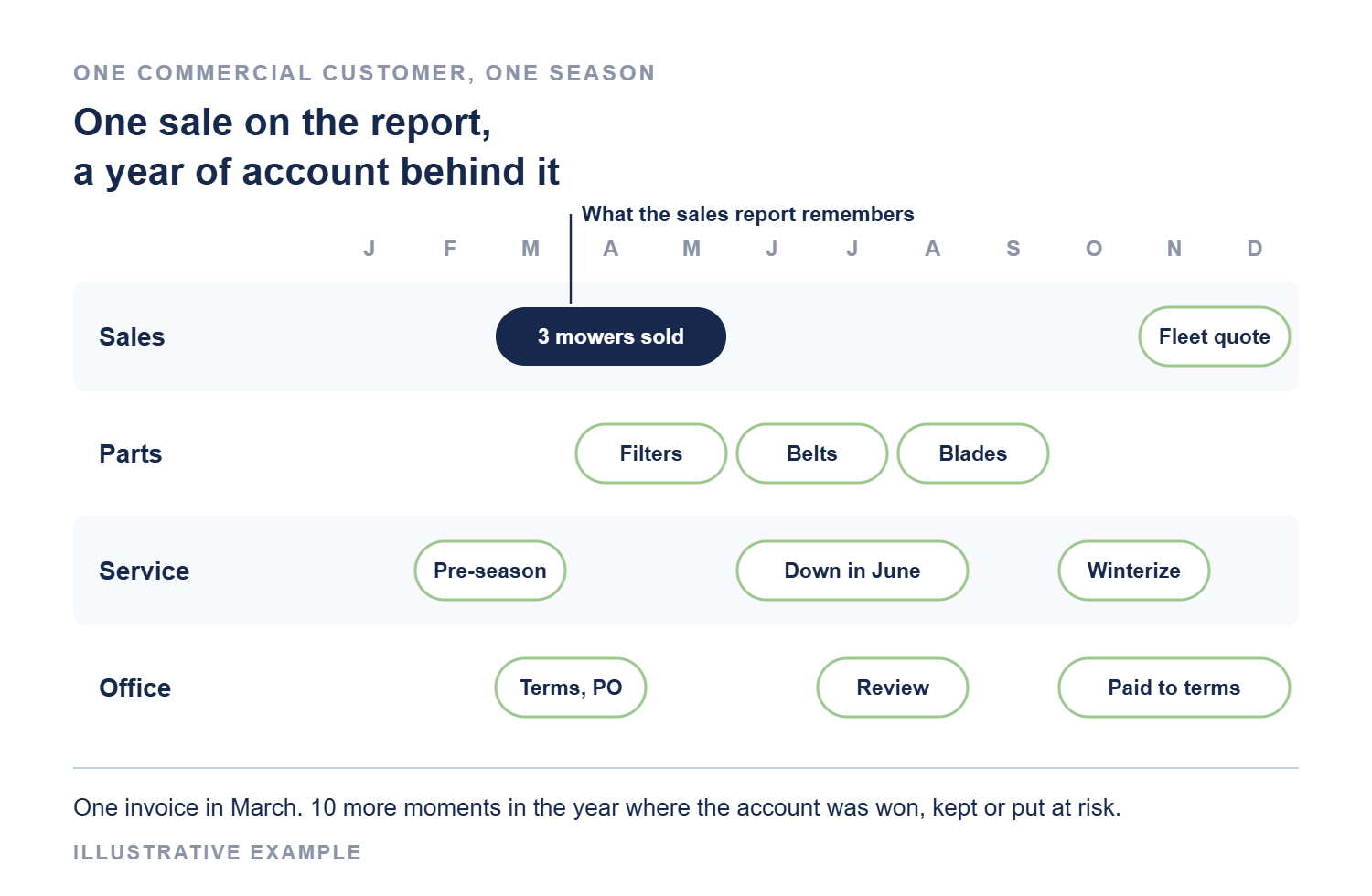
The landscaper in June
A landscaper calls on a Tuesday morning in June with a mower down. To the shop, it could look like one more repair in a full schedule. To the customer, it’s a crew standing idle in the busiest part of the year.
Handled as a transaction, the unit gets a ticket and a place in line. Handled as an account, the service writer asks what’s down, how many crews it affects, what jobs are scheduled and whether there’s a backup machine. Parts checks availability while service sets a realistic expectation. And someone notices that the account runs three similar units that are all nearing replacement age.
Nobody promised magic. The repair got done on an honest timeline. But the dealership also saw the next conversation — maintenance planning, a backup unit, and a fleet replacement — instead of waiting for the customer to bring it up somewhere else.
Ask the account questions
Commercial selling starts with understanding how the customer operates. The questions aren’t complicated. They just go one layer deeper than the product.
01
How is this equipment used, and how hard?
02
How many units do you run?
03
What happens to your business if this machine goes down?
04
Who approves purchases, and what paperwork do they need?
05
How do you handle maintenance now?
06
Are you replacing one unit, or planning a change across the fleet?
Each answer changes something practical: the recommendation, the urgency, the documentation, the follow-up. And each one is worth writing down, so the next person who talks to that customer doesn’t have to start over.
Priority has to be a rule, not a promise
The fastest way to damage a service department is to let commercial urgency become informal. One customer gets bumped ahead because they called loudly. Then another. Soon the schedule means nothing, retail customers wait longer than they were told, and the technicians stop believing any plan will hold.
Priority for commercial work is reasonable. It just needs to be defined: what counts as an emergency, what seasonal work gets reserved capacity, what can be scheduled, and who decides when the rules bend. Written down, priority protects the account and the shop at the same time. Left to whoever is at the counter, it protects neither.
The same is true of pricing. A discount to win a commercial deal is a margin decision and a precedent that follows every deal after it. It should be made on purpose, recorded, and reviewed — not granted again and again because nobody remembers what was agreed last time.
What the counter sees, and what the owner sees
Most decisions about commercial customers get made in the moment by whoever is on the phone or at the counter. They’re usually reasonable decisions. They’re just made without the view across the whole account that the owner has, or should have.
A customer asking for a discount — is also a margin decision, a precedent, and a signal of what the next deal will expect.
A fleet customer needing it first — is also a question of capacity, fairness to everyone else in line, and what the downtime costs them.
A municipal buyer asking for paperwork — is also an account that may renew every year if the paperwork is easy.
A landscaper replacing one mower — is also a possible fleet standard, a parts stream, a service stream and a referral.
A big account that pays slowly — is also cash the business has earned and is effectively lending out.
That last one deserves its own attention. High revenue doesn’t help much if the cash never arrives. Terms for commercial accounts — purchase order requirements, tax status, when payment is due — should be written down when the account is set up, and receivables should be part of every account review. A customer who pays late isn’t necessarily a bad customer. But the conversation is much easier when the terms were clear from the start.
What every key account needs
None of this requires a customer relationship system. It requires a few things to be true for the accounts that matter most.
A named person who owns the relationship
A record of the units they run, by serial number, with service history
Written terms: pricing, purchase order requirements, tax status and payment expectations
Priority rules the shop and the customer both understand
A regular look at activity, service load, margin kept and how they pay
That last review is where the economics become visible. Is the account growing, steady or slowing? Are repairs planned or always urgent? Do they pay to terms? What margin is left after discounts, rework and rush work? An account that looks large on the sales report can look very different once those questions are answered.
Start with five accounts
None of this needs to be rolled out across every customer at once. Pick the five commercial, fleet, municipal or farm accounts that matter most, and write down a short snapshot of each.
What kind of operation they run
What equipment they own, and how old it is
What happens to them when it’s down
The parts and service they need through the year
Any open quote or replacement coming up
Who owns the relationship, and when anyone last spoke to them
Five snapshots usually turn up something immediately: a quote that never got a follow-up call, a fleet that is due for replacement, an account with no clear owner, or one whose terms nobody can find. Fix what they reveal, then add the next five.
A commercial account is valuable when the relationship is repeatable, supportable, profitable, and worth the capacity it consumes.
Different treatment for commercial customers is fair when it’s based on business need and account value, not on who called last or who complains loudest. Make that visible, and the accounts that deserve the attention get it — and the ones that are costing money stop hiding behind their sales total.
How this connects
Area: Revenue — customers, and the value of a relationship over time.
Applies across: Operations and Administration — priority is a service decision, and terms and receivables are an office one.
Read next: Building Follow-Up That Doesn’t Rely on Memory — the habit that keeps open quotes and account conversations from going cold.
Also useful: Turning Work Orders Into a Production System — the service side of keeping commercial customers running.
ProfitEdge Systems helps independent retailers and dealers improve profitability and operating performance through consulting, training, and intelligence tools. See how we help →

Free checklist
The Physical Inventory Planning Checklist
Two pages. Everything to do six weeks, two weeks and one week out, the count-day rules, and a review sheet that shows the gross variance, not just the net. One email address, nothing else.
Free follow-up kit
The Follow-Up Kit
Four printable pieces: a short huddle playbook for managers, the huddle form, a one-page field job aid, and a guide to turning the reports you already have into working lists. One email address, nothing else.
Free self-check
The Exit-Readiness Self-Check
Two pages. What still runs through you, the four questions a buyer or successor will ask, and a place to name your first three gaps. One email address, nothing else.
Free worksheet
The Shrink Investigation Worksheet
Two pages. A five-step check for every significant variance, an item log, where shortages hide in an equipment and hardware store, and how to spot a pattern before anyone is accused. One email address, nothing else.
Free self-check
The Small-Office Controls Self-Check
Two pages. Who does what on a payment, the five control activities, first fixes for a two-person office, and a login review. One email address, nothing else.
Free counter log
The Missed-Sale Log
Two pages. A counter log for every request you couldn’t fill, a weekly review that gives each signal an owner, and a place to track patterns across the month. One email address, nothing else.
Free account review
The Commercial Account Review
Two pages. A snapshot of your five most important commercial, fleet, municipal or farm accounts: what they run, the terms on file, and what each account really earns. One email address, nothing else.
Free planning sheet
The Before-the-PO Planning Sheet
Two pages. Why you’re buying it, four questions to answer before the cash goes out, the program on one page, and how to run a controlled test when the evidence is thin. One email address, nothing else.
Free template
The Customer Deposit Policy Template
Two pages. Write your deposit terms once, set how deposits are handled at the counter, and reconcile open deposits every month. One email address, nothing else.
Free worksheet
The Revenue Leak Worksheet
Two pages. Check warranty, co-op and programs, labor, vendor terms and floorplan, put a yearly dollar figure on each leak, and rank them against shrink with an owner for every fix. One email address, nothing else.
Free morning review
The Work Order Stage Review
Two pages. A morning sheet for every open job, with its stage, what it’s waiting on, the next step and who owns it, plus a stage-by-stage count of where work stalls. One email address, nothing else.
Free monthly review
Monthly Margin Questions
Two pages. The four questions an owner should be able to answer every month, set out as a sheet to fill in when the statement arrives, with a checklist of where margin drifts. One email address, nothing else.
Free planning sheet
The Decision-First Report Request
Two pages. Before asking for a new report or a new system, write down the decision, who makes it, how often, what counts as an exception and whether the data can be trusted. One email address, nothing else.
Free working sheet
The Month-End Exception Review
Two pages. The five questions worth settling before you build anything, and a daily / weekly / before-the-close sheet with the owner column left blank for your own names. One email address, nothing else.

Shrink Isn’t Only Theft
When the count comes up short, theft is the first thought. Often the stock was never there, or it left without anyone recording it. Sort the cause before you act.

Trust Is Not a Control
Controls are not a judgment about anyone. They are a judgment about whether one person could move money and hide it, and they protect the people you trust most.
Commercial and Fleet Customers Are Different
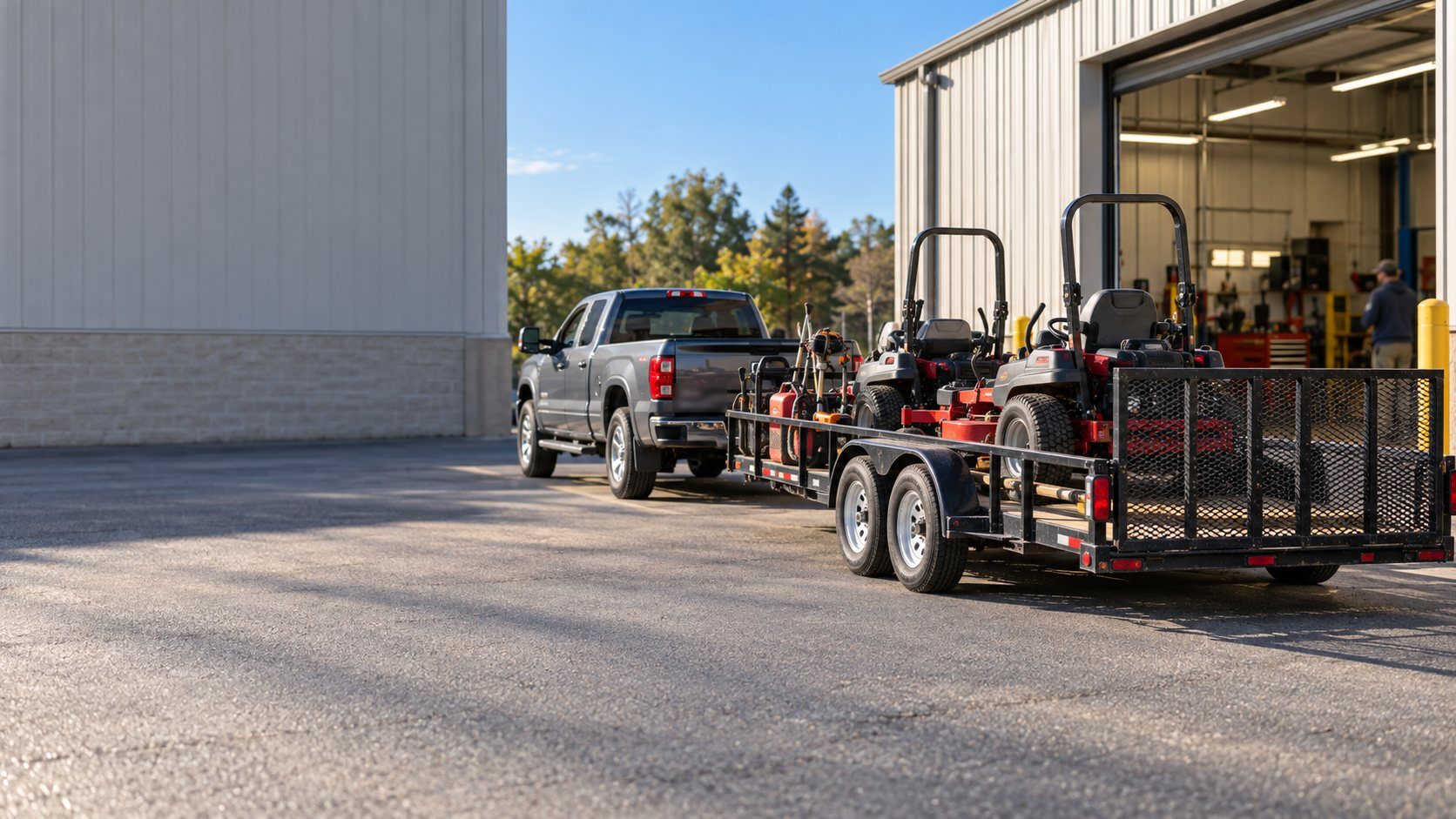
A down mower is a frustrating weekend for a homeowner. For a landscaper, it is a crew standing still.

Customer Deposits Aren’t Your Money Yet
A deposit is money you are holding, not money you have earned. Book it as a sale and the numbers start telling a story that is not true.
Bring the problem you keep re-solving
Most of what ends up in these articles started as a question from a shop owner or a dealer principal. If something here sounds like your month, say so and we will look at it together.
