
Most loss prevention starts and ends with shrink. That loss is real, but it’s the smaller half of the picture. The larger half is money the business earned and never collected, and no transaction ever records it.
Ask an owner about loss prevention and the conversation usually turns to theft. Cameras, locked cases, the high-value items behind the counter, the number that comes back from the physical inventory.
All of that matters. But it describes only one kind of loss, and it’s often not the expensive one.
Two kinds of loss
Actual loss
Money or goods lost after you have them
Theft, fraud, error and damage. It shows up as a variance or a write-off, so at least somebody sees it.
Opportunity loss
Money you earned that never arrives
Warranty never claimed, co-op forfeited, rebates missed, labor under-recovered, work never billed. Nothing records it, so nobody sees it.
The first kind is what people mean when they say loss prevention. The second can be larger, and it rarely gets measured, because there’s no event to measure. A warranty claim that was never filed doesn’t produce a variance. It simply never turns into money.
What the whole picture looks like
Take a dealer that watches its shrink number closely. It’s counted every year, it’s under control, and everyone knows roughly what it is.
Now ask a different question: what did the business earn last year that it never collected? Nobody keeps that list, but it usually looks something like this.
Technician time paid for but never billed
Warranty work never claimed, filed too late, or short-paid and never followed up
Co-op and program money that expired unclaimed
Vendor pricing and payment discounts the business was entitled to and never got
The number being watched
Shrink
Counted, reported and discussed every year. One line, and a well-understood one.
The number nobody keeps
Uncollected
Four or more lines, none of them on a report. Even a business that files most of its warranty and claims most of its programs leaves something behind in each.
Each of those leaks feels manageable on its own. A few points of warranty here, some forfeited co-op there. Added together, they can rival or exceed the shrink number that gets all the attention, and the only way to know is to add them up for your own business.
That’s also why loss prevention can’t belong to one department. Shrink is an inventory problem. Warranty and program money are handled in the back office. Labor recovery happens in service. A business that fixes one and ignores the others has closed one door and left the larger ones open.
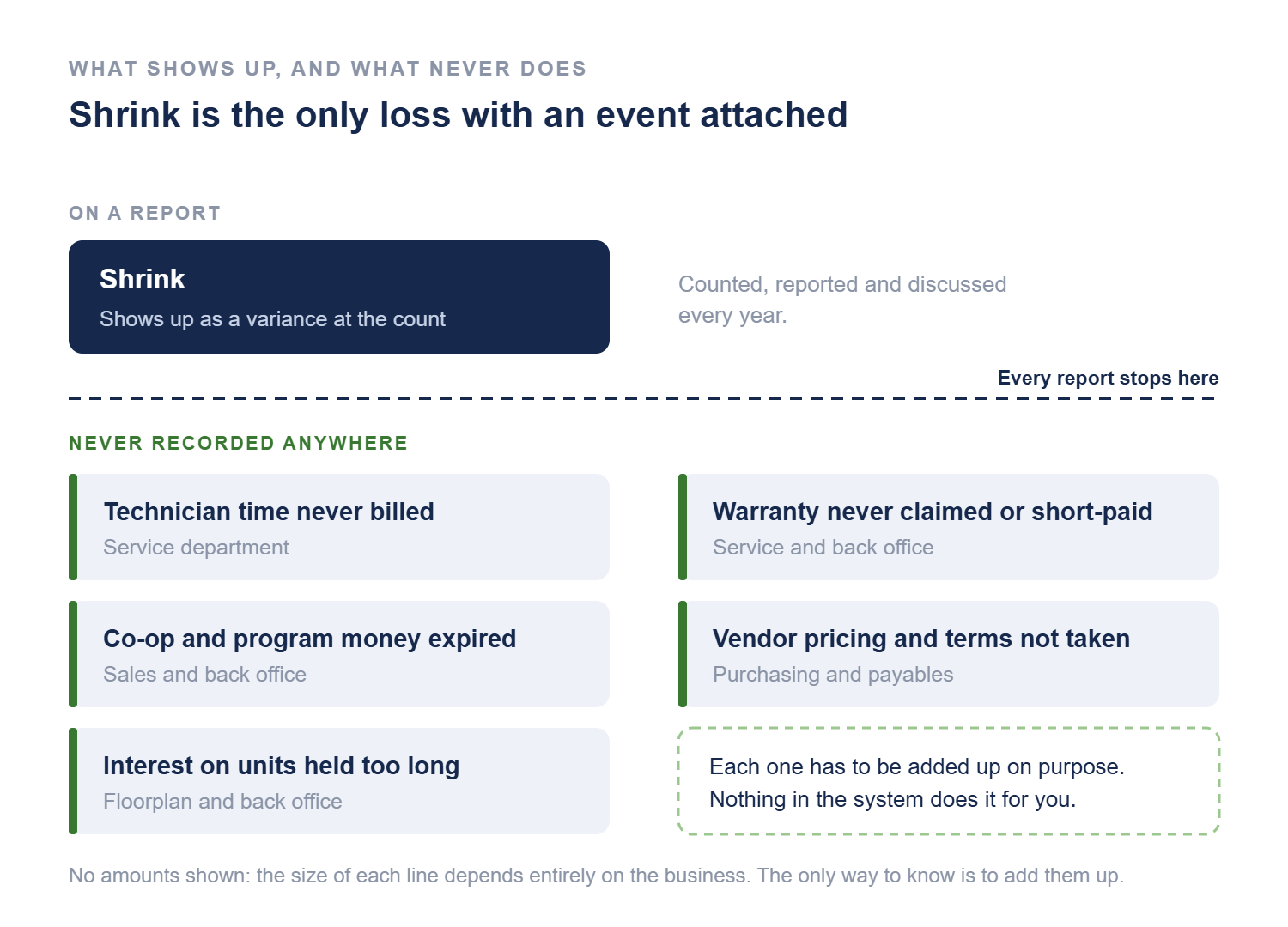
Where the uncollected money usually is
Opportunity loss isn’t one problem. It turns up in a handful of places, each with its own way of going wrong and its own fix. These four are worth checking first.
Warranty. A warranty claim is a receivable. The work has been done, the technician has been paid and the part has been used, so the money is already earned. It goes missing in small, ordinary ways: the repair order is never coded as warranty, the claim is filed after the manufacturer’s window and denied no matter how valid it was, the cause and correction were never written down, or a denial gets written off instead of corrected and resubmitted. And a claim that was filed but never matched to a payment looks exactly like one that was paid.
File claims at least weekly, so nothing ages toward its deadline
Capture cause and correction on the repair order at the time of the repair
Treat denials and short-pays as a work queue, not a write-off
Track every claim until the money arrives
Co-op, rebates and programs. This money has been earned by selling the product and meeting the terms. Nothing stands between the business and the payment except claiming it correctly and on time. Co-op is the clearest case, because it’s use-or-lose: whatever isn’t spent and claimed inside the period goes back to the manufacturer for nothing. Programs go unclaimed for predictable reasons: nobody has a full list of what the business is entitled to, deadlines pass unnoticed, or the proof was never kept.
Keep one list of every program, with what qualifies, what it pays and when it is due
Put every deadline and the remaining co-op balance on a calendar
Keep the proof as it happens: the ad, the invoice, the qualifying sale
Labor. In the service department, the business buys a technician’s time as payroll and sells it as billed labor. The leak is the gap between hours paid and hours billed: jobs never fully written up, comebacks redone for free, internal work never charged, warranty time billed below the customer rate. Each of those is labor the business paid for that produced no revenue. The starting point is simply capturing all billable time on the repair order and knowing, at least roughly, the effective labor rate.
Floorplan. For dealers financing units, anything that stays on the lot too long becomes a financing cost as well as an inventory problem: curtailment payments, interest, and units sold but not reconciled to the floorplan. It’s a good example of a loss that neither the inventory report nor the financial statements fully shows on its own.
The common thread is ownership. Warranty passes through the technician, the service writer and the bookkeeper. Programs span sales, parts and the office. When the work is split between people, claims fall between them. Each of these needs one named person who is responsible for the money arriving, even if others feed the process.
Shrink still matters, and most of it is not theft
None of this is an argument for ignoring shrink. It is an argument for understanding what it is made of. Shrink is simply the gap between what the system says you own and what’s actually there, and that gap has three very different sources.
01
Operational: damage, breakage, store use, parts used on warranty jobs.
02
Transactional: missed receipts, posting errors, receiving discrepancies, returns handled wrong.
03
Unknown: no cause can be found. Theft falls here, along with misplacement and unexplained variance.
The first two are process problems, and they’re almost entirely within the business’s control. That’s why the first step with any shortage is to confirm the count was right, then read the transaction history, before anyone assumes something was taken. A variance is a symptom. The process that created it is the problem.
The parts counter is a good example of how the two kinds of loss overlap. A technician pulls a belt and a set of plugs to finish a job, the job closes with the labor on it and only some of the parts, and nobody took anything. The inventory comes up short at the count. The revenue that should have come with those parts never arrived at all.
Controls are protection, not accusation
The most common reason an independent business under-invests in controls is trust. The office manager is family. The bookkeeper has been there twenty years. The parts manager has never given anyone a reason to doubt them.
Trust and controls are not substitutes, though. When one person can move money and also record it, or handle product and also adjust the system for it, that person is the automatic suspect in any loss, however honest they are. Separating those duties is what clears them.
The message is not “we suspect you.” It is “we are protecting the business, and clearing you of suspicion if anything ever goes wrong.”
A small office can’t separate every duty, and it doesn’t need to. Start with the most dangerous concentration, usually whoever can both move money and record it. Where duties can’t be split, the owner’s own review becomes the control. And check the simple things: whether people who left still have system logins, whether cash is counted against the records, and whether anyone looks at voids, overrides and adjustments on a schedule.
Rank the leaks by dollars
The useful version of loss prevention is a single, ranked list: every place money is leaking or never arriving, what each one is worth in a year, and who owns the fix. That list almost always looks different from the one the owner would have written from memory.
Where to start
Look at inventory, the back office and day-to-day operations, not just the stockroom
Check that warranty claims, program money and labor are actually being collected
Confirm the basic controls and the paperwork behind them are in place
Work out which kind of loss is larger for you, then put your attention there
The good news in all of this is the same as with margin. The money is usually already inside the business. Opportunity loss is often the fastest to recover, because the customer has already been served and the work has already been done. It only has to be collected.
How this connects
Area: Loss Prevention — the pillar that runs through all the others: where value leaks out, and how it’s found.
Applies across: Operations, Administration and Revenue — shrink is counted in inventory, but uncollected money is found in the back office and the service department.
Read next: Getting a Physical Inventory You Can Trust — the count that measures shrink, and how to make sure the number means something.
Also useful: Turning Work Orders Into a Production System — where under-recovered labor and unbilled parts usually start.
ProfitEdge Systems helps independent retailers and dealers improve profitability and operating performance through consulting, training, and intelligence tools. See how we help →

Free checklist
The Physical Inventory Planning Checklist
Two pages. Everything to do six weeks, two weeks and one week out, the count-day rules, and a review sheet that shows the gross variance, not just the net. One email address, nothing else.
Free follow-up kit
The Follow-Up Kit
Four printable pieces: a short huddle playbook for managers, the huddle form, a one-page field job aid, and a guide to turning the reports you already have into working lists. One email address, nothing else.
Free self-check
The Exit-Readiness Self-Check
Two pages. What still runs through you, the four questions a buyer or successor will ask, and a place to name your first three gaps. One email address, nothing else.
Free worksheet
The Shrink Investigation Worksheet
Two pages. A five-step check for every significant variance, an item log, where shortages hide in an equipment and hardware store, and how to spot a pattern before anyone is accused. One email address, nothing else.
Free self-check
The Small-Office Controls Self-Check
Two pages. Who does what on a payment, the five control activities, first fixes for a two-person office, and a login review. One email address, nothing else.
Free counter log
The Missed-Sale Log
Two pages. A counter log for every request you couldn’t fill, a weekly review that gives each signal an owner, and a place to track patterns across the month. One email address, nothing else.
Free account review
The Commercial Account Review
Two pages. A snapshot of your five most important commercial, fleet, municipal or farm accounts: what they run, the terms on file, and what each account really earns. One email address, nothing else.
Free planning sheet
The Before-the-PO Planning Sheet
Two pages. Why you’re buying it, four questions to answer before the cash goes out, the program on one page, and how to run a controlled test when the evidence is thin. One email address, nothing else.
Free template
The Customer Deposit Policy Template
Two pages. Write your deposit terms once, set how deposits are handled at the counter, and reconcile open deposits every month. One email address, nothing else.
Free worksheet
The Revenue Leak Worksheet
Two pages. Check warranty, co-op and programs, labor, vendor terms and floorplan, put a yearly dollar figure on each leak, and rank them against shrink with an owner for every fix. One email address, nothing else.
Free morning review
The Work Order Stage Review
Two pages. A morning sheet for every open job, with its stage, what it’s waiting on, the next step and who owns it, plus a stage-by-stage count of where work stalls. One email address, nothing else.
Free monthly review
Monthly Margin Questions
Two pages. The four questions an owner should be able to answer every month, set out as a sheet to fill in when the statement arrives, with a checklist of where margin drifts. One email address, nothing else.
Free planning sheet
The Decision-First Report Request
Two pages. Before asking for a new report or a new system, write down the decision, who makes it, how often, what counts as an exception and whether the data can be trusted. One email address, nothing else.
Free working sheet
The Month-End Exception Review
Two pages. The five questions worth settling before you build anything, and a daily / weekly / before-the-close sheet with the owner column left blank for your own names. One email address, nothing else.

Shrink Isn’t Only Theft
When the count comes up short, theft is the first thought. Often the stock was never there, or it left without anyone recording it. Sort the cause before you act.

Trust Is Not a Control
Controls are not a judgment about anyone. They are a judgment about whether one person could move money and hide it, and they protect the people you trust most.

Commercial and Fleet Customers Are Different
A down mower is a frustrating weekend for a homeowner. For a landscaper, it is a crew standing still.

Customer Deposits Aren’t Your Money Yet
A deposit is money you are holding, not money you have earned. Book it as a sale and the numbers start telling a story that is not true.
Bring the problem you keep re-solving
Most of what ends up in these articles started as a question from a shop owner or a dealer principal. If something here sounds like your month, say so and we will look at it together.
