
Slow inventory is a cash question. An aging report answers a date question. That mismatch is why the report gets opened every few months and the money stays exactly where it was.
Most retailers and dealers know they’re carrying some slow-moving inventory. The harder part is deciding what to do about it.
An aging report can identify hundreds or thousands of items that haven’t sold recently. That is useful. But it creates a problem of its own: when everything on the report looks like an issue, it’s difficult to know where to start.
The result is usually familiar. The report gets reviewed occasionally, a few obvious items get handled, and the larger problem stays exactly where it was.
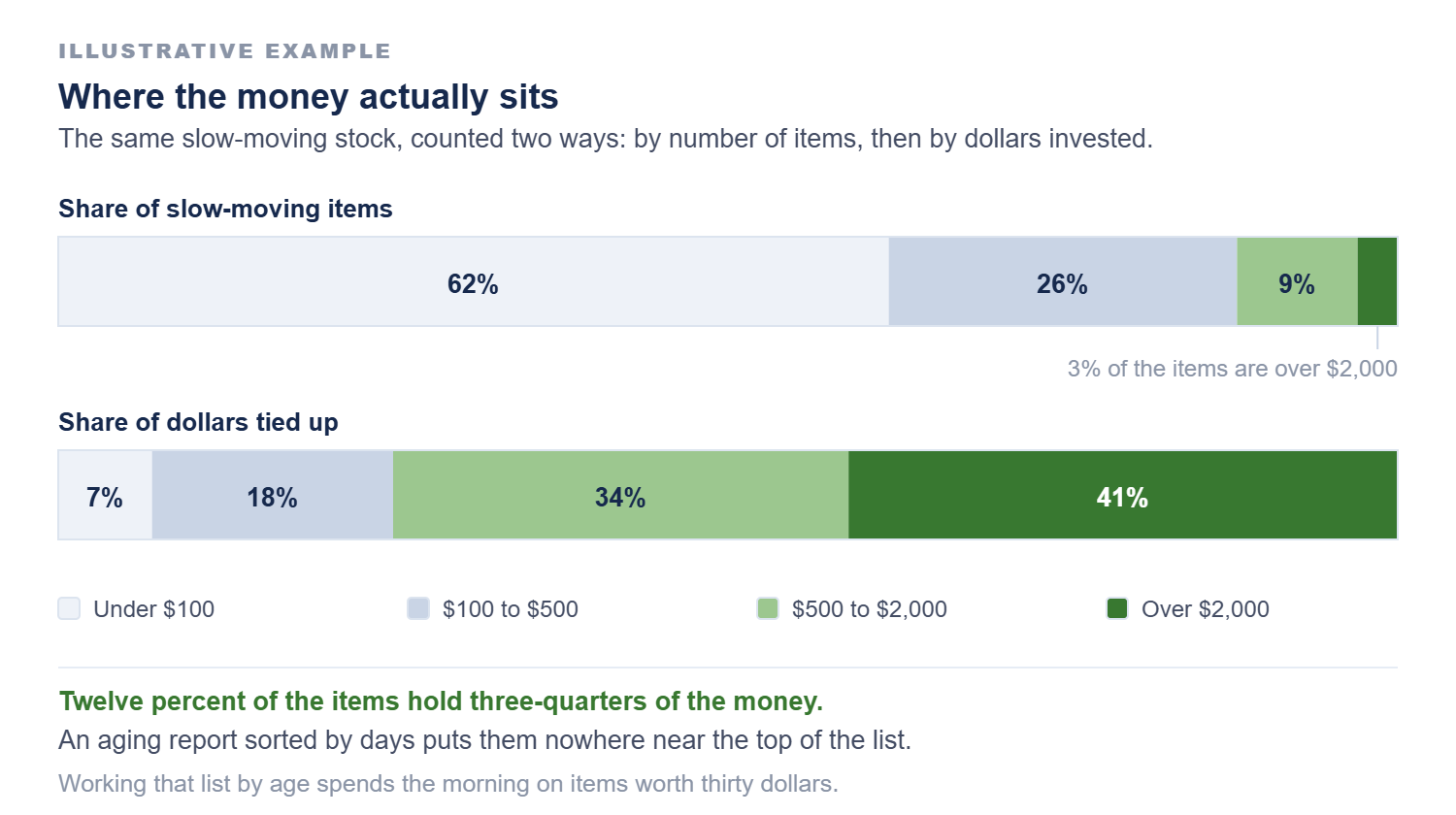
Age matters. Dollars matter more.
Suppose you have two items. The first hasn’t sold in 420 days. You have one on hand, and your investment is $32. The second hasn’t sold in 230 days. You have nine on hand, and your investment is $2,100.
Sorted by age, the first item looks like the bigger problem.
From a cash standpoint, the second item is far more important. This is why an aging report is a starting point, not a decision.
Age is only one of the questions
When you review slow inventory, a handful of questions put age in context.
How many do we have?
How much money is tied up?
When did it last sell?
How often has it sold historically?
Did we recently buy more?
Is demand seasonal?
Has the item been superseded?
Can it be returned?
Does a product line or key customer depend on it?
Is the current price part of the problem?
None of those questions tells you what to do on its own. Together they give you a much better picture than a date does.
Not all old inventory is bad inventory
Some slow-moving inventory belongs on the shelf. Service may need access to parts that sell infrequently. A seasonal product can go months without movement and still be exactly right to carry. You may stock an item on purpose because customers expect to find it, even though it doesn’t turn quickly.
That’s why labeling everything past a certain age as dead can mislead you. It’s a judgment call — but better information makes the judgment easier.
There’s a related situation that is easier to miss. Imagine an item that sells one or two units a year, and you have one on hand. That’s probably reasonable. Now imagine the same item with seven on hand. The item is not the problem. The quantity is.
Or take an item that gets reordered every time one sells, even though current stock already represents several years of normal demand. That’s not dead stock yet. But it’s where next year’s dead stock is being created.
A good inventory review asks both questions: what has already gone stale, and where are we carrying more than the sales history supports? The second one gives you the chance to act before the money is stuck.
Start where action can matter
If your aging report has 2,000 lines on it, solving the whole list isn’t a realistic plan. Start by isolating the items where a decision could change something.
Where to look first
The largest dollars tied up in weak-moving items
Products with unusually high quantities relative to sales
Items still being purchased despite limited movement
Products that can still be returned
Aging items where the price may be contributing to the problem
Superseded or obsolete products with meaningful investment
Instead of asking someone to work the dead-stock report, hand them a manageable group of items worth reviewing. Twenty meaningful decisions are usually worth more than staring at 2,000 lines.
Getting rid of it is not the only option
Once an item deserves attention, the next question isn’t automatically how to make it disappear. There are more choices than that, and the right one depends on the item.
Stop replenishing
Reduce the quantity
Return it
Transfer it
Change the price
Bundle it
Promote it
Use it in service
Keep it on purpose
Write it down
Dispose of it
That range of options is another reason a blanket age rule is rarely enough on its own.
This is really a cash question
Inventory on a shelf is money. When it sells, that money comes back into the business and can go to work again. When it doesn’t sell, the cash stays where it is.
That matters because the same dollars could be doing something else — faster-moving inventory, payroll, equipment, facility work, paying down borrowing, taking a buying opportunity, or simply creating some breathing room.
Which makes slow inventory more than a parts or purchasing issue. It is a financial issue for the whole business.
Try it with your own numbers
What’s slow stock costing you to keep?
Illustrative example figures. Replace them with your own. Start with the items where a decision could change something: the largest dollars, the quantities out of line with sales, and anything that can still be returned.
Where do we have meaningful dollars tied up in inventory that no longer matches the way we actually sell?
That question produces a far more useful conversation than “we need to clean up our dead stock.”
Age still matters. But now you’re looking at age alongside quantity, investment, demand, and the role the item plays in the business. You’re no longer trying to make an enormous report disappear. You’re deciding where action makes the biggest difference — which is a much more practical place to start.
How this connects
Area: Operations — inventory and the cash tied up in it.
Applies across: Revenue and Executive — buying decides what you own, and what you own decides what your cash is doing.
Read next: Turning Work Orders Into a Production System — the same problem in the service department, where the report also fails to say what’s actually stuck.
ProfitEdge Systems helps independent retailers and dealers improve profitability and operating performance through consulting, training, and intelligence tools. See how we help →

Free checklist
The Physical Inventory Planning Checklist
Two pages. Everything to do six weeks, two weeks and one week out, the count-day rules, and a review sheet that shows the gross variance, not just the net. One email address, nothing else.
Free follow-up kit
The Follow-Up Kit
Four printable pieces: a short huddle playbook for managers, the huddle form, a one-page field job aid, and a guide to turning the reports you already have into working lists. One email address, nothing else.
Free self-check
The Exit-Readiness Self-Check
Two pages. What still runs through you, the four questions a buyer or successor will ask, and a place to name your first three gaps. One email address, nothing else.
Free worksheet
The Shrink Investigation Worksheet
Two pages. A five-step check for every significant variance, an item log, where shortages hide in an equipment and hardware store, and how to spot a pattern before anyone is accused. One email address, nothing else.
Free self-check
The Small-Office Controls Self-Check
Two pages. Who does what on a payment, the five control activities, first fixes for a two-person office, and a login review. One email address, nothing else.
Free counter log
The Missed-Sale Log
Two pages. A counter log for every request you couldn’t fill, a weekly review that gives each signal an owner, and a place to track patterns across the month. One email address, nothing else.
Free account review
The Commercial Account Review
Two pages. A snapshot of your five most important commercial, fleet, municipal or farm accounts: what they run, the terms on file, and what each account really earns. One email address, nothing else.
Free planning sheet
The Before-the-PO Planning Sheet
Two pages. Why you’re buying it, four questions to answer before the cash goes out, the program on one page, and how to run a controlled test when the evidence is thin. One email address, nothing else.
Free template
The Customer Deposit Policy Template
Two pages. Write your deposit terms once, set how deposits are handled at the counter, and reconcile open deposits every month. One email address, nothing else.
Free worksheet
The Revenue Leak Worksheet
Two pages. Check warranty, co-op and programs, labor, vendor terms and floorplan, put a yearly dollar figure on each leak, and rank them against shrink with an owner for every fix. One email address, nothing else.
Free morning review
The Work Order Stage Review
Two pages. A morning sheet for every open job, with its stage, what it’s waiting on, the next step and who owns it, plus a stage-by-stage count of where work stalls. One email address, nothing else.
Free monthly review
Monthly Margin Questions
Two pages. The four questions an owner should be able to answer every month, set out as a sheet to fill in when the statement arrives, with a checklist of where margin drifts. One email address, nothing else.
Free planning sheet
The Decision-First Report Request
Two pages. Before asking for a new report or a new system, write down the decision, who makes it, how often, what counts as an exception and whether the data can be trusted. One email address, nothing else.
Free working sheet
The Month-End Exception Review
Two pages. The five questions worth settling before you build anything, and a daily / weekly / before-the-close sheet with the owner column left blank for your own names. One email address, nothing else.

Shrink Isn’t Only Theft
When the count comes up short, theft is the first thought. Often the stock was never there, or it left without anyone recording it. Sort the cause before you act.

Trust Is Not a Control
Controls are not a judgment about anyone. They are a judgment about whether one person could move money and hide it, and they protect the people you trust most.

Commercial and Fleet Customers Are Different
A down mower is a frustrating weekend for a homeowner. For a landscaper, it is a crew standing still.

Customer Deposits Aren’t Your Money Yet
A deposit is money you are holding, not money you have earned. Book it as a sale and the numbers start telling a story that is not true.
Bring the problem you keep re-solving
Most of what ends up in these articles started as a question from a shop owner or a dealer principal. If something here sounds like your month, say so and we will look at it together.
