
Every purchase order answers one question: why are we buying this? The answer decides how much cash goes onto the shelf, and how long it stays there.
Most buying decisions sound reasonable at the time. A customer asked for it. Someone on staff believes in it. The rep says the program ends Friday. All three can be good reasons. They’re also very different reasons, and each one carries a different kind of risk.
A dealer can buy the right product for the wrong reason, too much of a good product for a good reason, or a product that looks exciting and doesn’t match its customers. In every case the result is the same: cash committed to inventory that doesn’t move the way anyone expected.
Four reasons a business buys
Need
Customers, sales history or service work show real demand. The risk is the quantity: too little means stockouts, too much still traps cash.
Want
The store likes it or wants to try it. The idea may be good, but it’s unproven with your customers.
Push
A vendor deal, program target or deadline is creating the urgency. The risk is buying for the vendor instead of the customer.
Bet
The owner chooses to test a new category or customer group on purpose. That needs a plan, a margin target and a way out.
Good ideas can come from any of these places. The point is not to dismiss wants or refuse vendor programs. It is to know which one you’re acting on, because each calls for a different amount of caution.
Vendor programs are not the enemy
Independent dealers work inside a network of manufacturers, distributors and finance partners, and those partners bring real value. They also bring pressure: early-order deals, dating terms, volume targets, freight minimums, rebate tiers and limited-time promotions.
A rep sees a lot of dealers and often knows the product well. But the rep doesn’t carry your cash, know your local customers the way you do, or own the inventory that is still on the shelf next spring. The store still has to decide whether the offer fits its customers, its cash, its service capacity and its season.
What you hear, and what to ask
“Everybody is buying this.” — Are our customers buying it, and what’s the proof?
“The margin is great.” — Will it sell fast enough, and can we support it well enough, to keep that margin?
“The program ends Friday.” — Does that deadline serve us, or only the vendor?
“We should have it just in case.” — What does just in case cost if it doesn’t move?
“We can always sell it later.” — At what margin, and after how long?
A strong vendor relationship works in both directions. The rep brings product knowledge, programs and a view across many dealers. The dealer brings knowledge of its own customers, cash and capacity. The best buying decisions use both — and sometimes that means adjusting the size or timing of a program, and sometimes it means taking it on in full with a proper plan behind it.
The invoice is not the true cost
Vendor programs change the economics of a buy, and not always in the direction they appear to. The invoice price is the beginning of the story. The real cost of a purchase comes after freight, payment terms, whatever program money is actually collected, and the risk of the product taking longer to sell than planned.
Rebates — only count once the product sells, the claim is filed correctly and the money arrives.
Volume bonuses — can encourage buying beyond demand just to reach the next tier.
Dating terms — help only if the product turns into cash before the payment comes due.
Freight minimums — invite extra items onto the order just to reach the threshold.
Co-op — is only worth something if someone uses it and claims it before it expires.
Picture a dealer who buys extra handheld units to qualify for a volume bonus. On paper the program looks attractive. In practice, the extra units sell slowly and need markdowns late in the season, and the rebate claim goes in late. Some of the program money comes back, but not enough to cover the extra inventory risk. A lower invoice price on product that doesn’t move can easily cost more than a slightly higher price on product that sells cleanly.
The fix is not to stop using programs. It is to put each program decision on one page before agreeing to it: the expected sell-through, when the cash goes out and when it should come back, freight, the risk of markdowns, who owns the claim, and the deadline. Then let that page make the decision, not the tier threshold.
Evidence before commitment
The discipline is to turn the idea into evidence before committing much cash to it. A customer request might mean stock it. It might also mean special-order it once and see whether anyone asks again. A vendor program might be worth taking in full, or worth taking at half the size.
Four questions are enough to slow a decision down without killing it:
What evidence supports this buy?
How much cash does it commit, and for how long?
What customer need does it serve?
What do we do if it doesn’t move?
That last one is the question most often skipped, and the one that matters most later. If nobody decided in advance what happens to slow stock, it usually just stays — and becomes the dead stock someone has to deal with a year from now.
When the expansion is coming anyway, plan for it
Not every expansion is optional, and not every one should be. When the rep for your primary mower or handheld line brings a new category, such as a battery-powered range, it often comes from a partner who knows the market and wants the store to succeed. Sometimes taking it on is part of staying in good standing with that line. Pushing back is rarely the real answer.
The trouble starts when the product arrives before the store is ready for it. The salespeople haven’t been trained on it. Service has no tools, parts or know-how to support it. There’s no clear place on the floor to show it. Customers who have bought gas equipment for years haven’t been given a reason to look. The product doesn’t move, and the store decides the line was the problem — when what was really missing was a plan.
Before the first shipment lands
Sales staff trained on the product and on who it is for
Service ready: technician training, tools and the parts to support it
A real place on the floor, and a plan for showing it to existing customers
An opening quantity matched to the plan, agreed with the rep
The support the vendor offers — training, display, co-op — actually scheduled and used
A date to review how it’s selling, and what changes if it’s slower than expected
Most of that is work a good rep will happily help with. The conversation shifts from “how much will you take?” to “what do we need in place for this to sell here?” — which is a better conversation for both sides.
A new line that arrives with a plan behind it gets a fair chance to succeed. One that arrives without one usually gets blamed for results it never had a chance to produce.
When the line is coming either way, the question is not whether to take it. It is whether the store will be ready to sell it when it arrives.
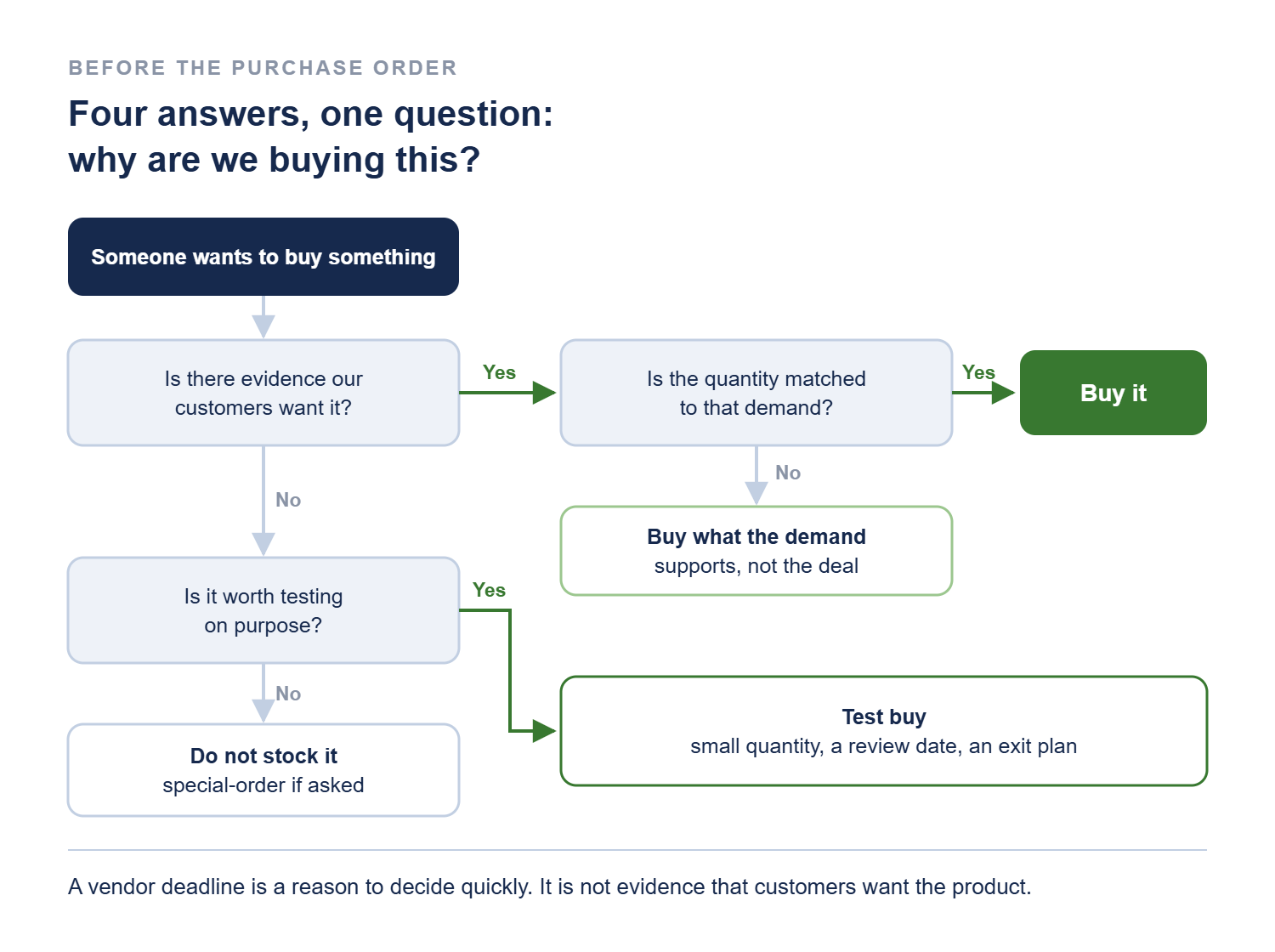
What a controlled test looks like
When the evidence is thin but the idea is worth trying, a test buy is the middle path. It needs only a few things to be a real test rather than a hopeful guess.
A limited quantity
Staff who know how to sell it
Service ready to support it
A place on the floor where customers will see it
A date to review how it sold
An exit plan agreed up front: return, mark down, transfer, or stop reordering
When the review date arrives, the decision is easy because it was framed in advance: buy deeper, keep testing, or exit. What a test buy prevents is the slow drift where a product is neither working nor removed, and ends up as a write-down.
It also connects buying back to what customers actually ask for. The requests the parts counter hears and the special orders that keep repeating are exactly the evidence a buying decision should start from — which is why the person placing orders needs to see them.
How this connects
Area: Operations — purchasing, and the cash every buying decision commits.
Applies across: Revenue and Executive — what you buy should follow demand, and what it costs shows up in cash and margin.
Read next: Freeing Cash Trapped in Dead Stock — what to do with the buys that didn’t work out.
Also useful: You Cannot Sell Your Way to a Better Year — why money is made on the buy.
ProfitEdge Systems helps independent retailers and dealers improve profitability and operating performance through consulting, training, and intelligence tools. See how we help →

Free checklist
The Physical Inventory Planning Checklist
Two pages. Everything to do six weeks, two weeks and one week out, the count-day rules, and a review sheet that shows the gross variance, not just the net. One email address, nothing else.
Free follow-up kit
The Follow-Up Kit
Four printable pieces: a short huddle playbook for managers, the huddle form, a one-page field job aid, and a guide to turning the reports you already have into working lists. One email address, nothing else.
Free self-check
The Exit-Readiness Self-Check
Two pages. What still runs through you, the four questions a buyer or successor will ask, and a place to name your first three gaps. One email address, nothing else.
Free worksheet
The Shrink Investigation Worksheet
Two pages. A five-step check for every significant variance, an item log, where shortages hide in an equipment and hardware store, and how to spot a pattern before anyone is accused. One email address, nothing else.
Free self-check
The Small-Office Controls Self-Check
Two pages. Who does what on a payment, the five control activities, first fixes for a two-person office, and a login review. One email address, nothing else.
Free counter log
The Missed-Sale Log
Two pages. A counter log for every request you couldn’t fill, a weekly review that gives each signal an owner, and a place to track patterns across the month. One email address, nothing else.
Free account review
The Commercial Account Review
Two pages. A snapshot of your five most important commercial, fleet, municipal or farm accounts: what they run, the terms on file, and what each account really earns. One email address, nothing else.
Free planning sheet
The Before-the-PO Planning Sheet
Two pages. Why you’re buying it, four questions to answer before the cash goes out, the program on one page, and how to run a controlled test when the evidence is thin. One email address, nothing else.
Free template
The Customer Deposit Policy Template
Two pages. Write your deposit terms once, set how deposits are handled at the counter, and reconcile open deposits every month. One email address, nothing else.
Free worksheet
The Revenue Leak Worksheet
Two pages. Check warranty, co-op and programs, labor, vendor terms and floorplan, put a yearly dollar figure on each leak, and rank them against shrink with an owner for every fix. One email address, nothing else.
Free morning review
The Work Order Stage Review
Two pages. A morning sheet for every open job, with its stage, what it’s waiting on, the next step and who owns it, plus a stage-by-stage count of where work stalls. One email address, nothing else.
Free monthly review
Monthly Margin Questions
Two pages. The four questions an owner should be able to answer every month, set out as a sheet to fill in when the statement arrives, with a checklist of where margin drifts. One email address, nothing else.
Free planning sheet
The Decision-First Report Request
Two pages. Before asking for a new report or a new system, write down the decision, who makes it, how often, what counts as an exception and whether the data can be trusted. One email address, nothing else.
Free working sheet
The Month-End Exception Review
Two pages. The five questions worth settling before you build anything, and a daily / weekly / before-the-close sheet with the owner column left blank for your own names. One email address, nothing else.

Shrink Isn’t Only Theft
When the count comes up short, theft is the first thought. Often the stock was never there, or it left without anyone recording it. Sort the cause before you act.

Trust Is Not a Control
Controls are not a judgment about anyone. They are a judgment about whether one person could move money and hide it, and they protect the people you trust most.

Commercial and Fleet Customers Are Different
A down mower is a frustrating weekend for a homeowner. For a landscaper, it is a crew standing still.

Customer Deposits Aren’t Your Money Yet
A deposit is money you are holding, not money you have earned. Book it as a sale and the numbers start telling a story that is not true.
Bring the problem you keep re-solving
Most of what ends up in these articles started as a question from a shop owner or a dealer principal. If something here sounds like your month, say so and we will look at it together.
